#Industry News
How to Extend the Service Life of Rolling and Plain Bearings
How the right lubricant, precise dosing, and automatic lubricators measurably extend your bearing service life and reliably prevent unplanned downtime.
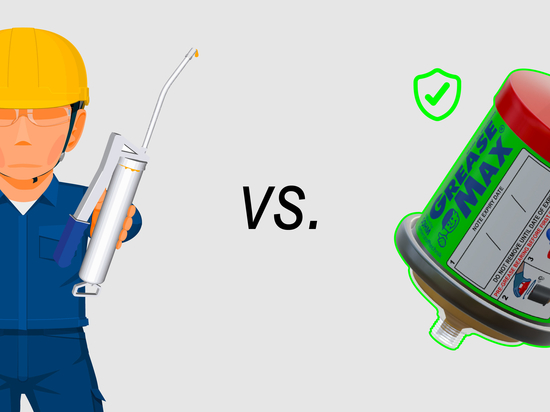
In practice, it is rarely the bearing itself that determines whether a machine runs reliably or fails prematurely. It is the lubrication. The majority of all bearing damage can be traced back to unsuitable or incorrectly applied lubrication. Wrong lubricant, wrong quantity, intervals that are too long, or contamination that has entered the system. The most common causes are not technical failures, but human and organisational inconsistencies: under-lubrication due to intervals that are too long or forgotten lubrication points, over-lubrication from too many strokes with the grease gun, irregular re-lubrication depending on the shift and availability of personnel, and the use of lubricants that do not match the application. Automatic lubricators address exactly these issues by structurally eliminating these inconsistencies from the process.
Consistent, demand-based lubricant supply as the foundation
The critical difference between manual and automatic lubrication lies not in the total quantity of lubricant used, but in the way it is delivered. With manual lubrication, large amounts of grease often enter the bearing in a short period of time. This creates high internal friction and temperature peaks. The lubricating film is too thick in the hours after lubrication, then too thin for weeks afterwards. A cycle of over- and under-supply that places a lasting strain on the bearing.
An automatic lubricator, by contrast, continuously supplies the bearing with small, defined quantities of grease. The lubricating film remains stable; viscosity, film thickness, and temperature stay within a narrow, consistent range and that is precisely what makes bearings last. Contact pressure in the contact zone decreases, micro-wear is reduced, and bearing service life increases measurably.
Clean, protected lubrication point: protection against the second most common cause of failure
Alongside incorrect quantity, contamination in the lubricant is one of the most frequent triggers of premature bearing wear. Dust, moisture, and abrasive particles enter the bearing clearances, contaminate the grease, and act as abrasives directly on the raceways. Closed lubrication systems keep the lubricant free from external ingress along the entire path from the source to the lubrication point. Continuously replenished fresh grease displaces aged lubricant from the bearing without the lubrication point ever needing to be openly accessible. This reduces corrosion and surface damage, and supports a significantly longer trouble-free operating life — especially in environments with elevated dust, moisture, or aggressive media.
Temperature as the key factor in lubricant service life
Temperature is one of the most important yet most frequently underestimated factors in bearing lubrication. According to the Arrhenius principle, the service life of a lubricant roughly halves with every temperature increase of approximately 10 °C. What lasts six months under normal operating conditions often lasts only three under elevated temperature — without this being externally visible.
Consistent, metered grease delivery directly counteracts this effect: less friction means less heat generation in the bearing. Operating temperature remains within the optimal range, the lubricant ages more slowly, and retains its protective function for longer. Practical trials with optimised lubrication regimes confirm that bearings both last longer and run more stably at reduced operating temperature. An effect that accumulates across the entire service life of the installation.
Planned maintenance instead of unplanned bearing replacements
An automatic lubricator operates independently of shift schedules, personnel availability, and the day-to-day demands of the maintenance department. Lubrication points that previously depended on routines and reminders are now supplied continuously and reproducibly. Every day, on every shift.
At the same time, defined operating periods of 1, 3, 6, or 12 months make maintenance plannable. Replacement dates can be documented, critical bearings specifically monitored, and maintenance windows scheduled in advance — rather than reacting to the next unexpected failure. Many downtimes that were previously accepted solely for re-lubrication purposes are eliminated entirely. The result is a maintenance approach that no longer reacts to bearing damage, but systematically prevents it through a controlled, predictable lubrication process.
What this means in practice for operators
Those who consistently apply automatic lubrication and carefully match lubricants, operating periods, and lubrication points benefit on several levels simultaneously. Bearing-related failures become less frequent, spare part and maintenance costs decrease, drive motors are measurably relieved through lower-friction bearings, and plant availability increases while maintenance becomes more plannable.
At the same time, lubricant consumption is reduced, because neither under- nor over-lubrication occurs any longer. Practical experience shows that lubricant consumption typically decreases by 20 to 25 percent when switching to automatic lubricators — while lubrication conditions improve and bearing service life extends.
GREASEMAX®: Continuous lubrication for longer bearing service life
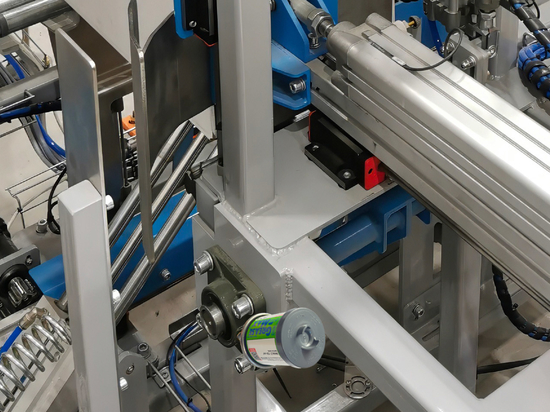
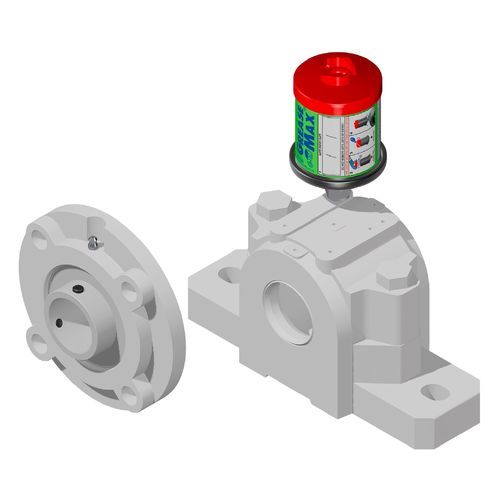
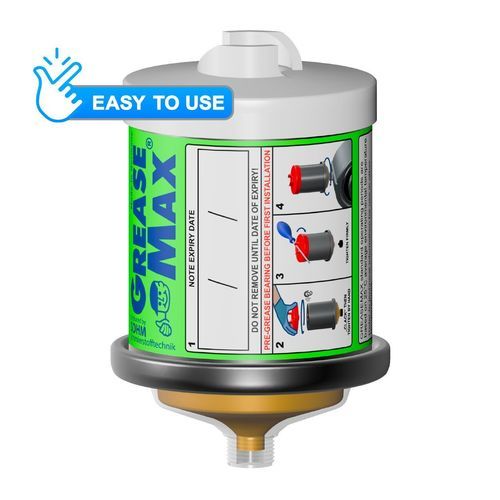
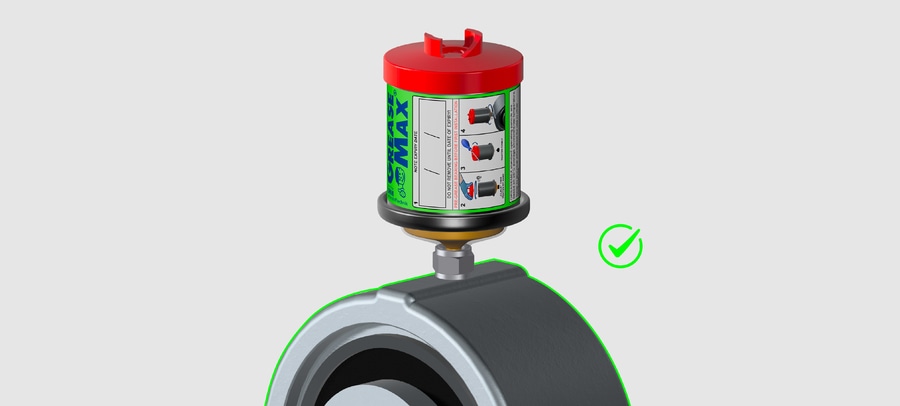
GREASEMAX® is a gas-driven single-point lubricator requiring no electricity, no electronics, and no external control. For extending bearing service life, it delivers the technically decisive characteristics: continuous delivery without intermittent over-greasing and without dry running between intervals keeps the lubricating film stable throughout the entire operating period. The closed lubrication system protects the lubricant from dust, moisture, and particle contamination on the way to the lubrication point. Operating periods of 1, 3, 6, or 12 months can be precisely matched to bearing size, load, and ambient temperature. The fully electronics-free design eliminates any susceptibility to interference from vibrations, heat, or electromagnetic influences. Flexible mounting directly at the bearing point or via hose connection up to two metres in length enables reliable supply even at hard-to-reach or hazardous lubrication points.
Conclusion:
Bearings that fail prematurely are in most cases not a material failure. They are the visible result of a lubrication regime that, at some point, no longer kept pace with the actual loads. Automatic lubrication is one of the most effective levers for extending the service life of rolling and plain bearings. It eliminates the typical errors of manual lubrication, stabilises temperature and lubricating film, protects against contamination, and makes the lubrication process plannable and reproducible.