#Industry News
Automatic Lubrication in the Pulp & Paper Industry
Discover how automatic lubricators prevent failures in the pulp and paper industry and sustainably reduce maintenance effort.
In the pulp and paper industry, continuity is not an option. It is a prerequisite. Production lines often run around the clock, under heat, moisture, and high mechanical loads. At the same time, energy prices are rising, environmental regulations are tightening, and competition leaves less room for avoidable losses. One central yet frequently underestimated weak point is lubrication. High speeds, extreme temperatures, moisture, and dust place continuous strain on bearings and seals. Even minor errors in re-lubrication, too little, too much, too late, generate friction, overheating, and in the worst case a shutdown that brings the entire production line to a standstill. Across extensive installations, manual lubrication is barely feasible in a reliable manner. Automatic lubricators close this gap, precisely, continuously, and without interrupting ongoing operations.
Why lubrication in the pulp and paper industry is particularly demanding
The loads in paper processing plants are varied and they rarely act in isolation. High speeds in dryers, pumps, and refiners place precise demands on grease supply: too much lubricant generates heat through churning losses, too little leads to dry running. Both accelerate wear considerably.
Moisture and aggressive media wash conventional lubricant out of bearings in wet process zones, while chemicals in pulp preparation attack seals and promote corrosion on bearing surfaces.
Temperature fluctuations in press and dryer sections create steep temperature gradients between cool, wet press zones and hot dryer areas. Grease ages faster under these alternating loads. A lubricating film that holds for months under normal conditions loses its effectiveness considerably sooner here.
Extensive installations with hard-to-reach lubrication points tie up personnel for manual lubrication rounds and yet regularly leave forgotten lubrication points behind. Many bearing locations are in hot, wet, or rotating areas that cannot be safely reached during operation.
Where automatic lubrication concretely helps along the production chain
In pulp production, moisture, aggressive media, and strongly fluctuating temperatures act simultaneously on conveyor belts, drums, pumps, washing presses, pulpers, motors, and refiners. Washout of lubricant is the most frequent cause of premature bearing wear in wet process zones. Automatic lubricators dose continuously, stabilise the lubricating film despite fluctuating speeds, and reliably protect bearings against corrosion. Conveyor and pump systems remain available, even under the conditions where manual lubrication reaches its limits most quickly.
In pulp processing, continuous operation and abrasive media dominate. Pumps, vacuum systems, thickeners, and electric motors work under high load and constant exposure to contamination. Precise re-lubrication is critical here to prevent dry running under high load or temperature. Automatic lubricators deliver a reliable, defined quantity of grease even under heavy contamination, and measurably reduce bearing failures along with the associated maintenance effort.
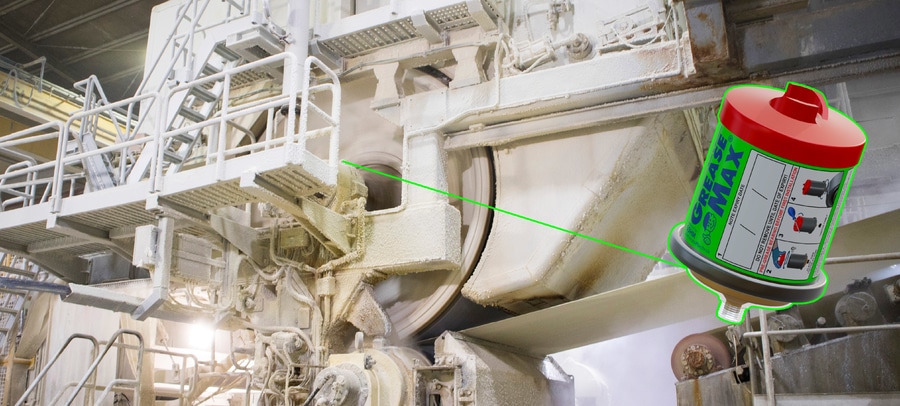
The paper machine is the heart of the installation, highly complex, sensitive, and representing considerable investment value. Presses, wire sections, roll drives, dryers, and motors must work continuously with precision and without interruption. Consistent grease supply at high cycle rates reduces friction, lowers energy consumption, and stabilises the paper web. Fluctuations in lubrication translate directly into product quality. Automatic lubrication with GREASEMAX® closes this weak point systematically.
In finishing and converting, precision determines quality and throughput. Cutting machines, roller conveyors, chain conveyor systems, and fans operate at high cutting and cycle speeds that require consistent component quality. Automatic lubrication ensures smooth running movements, reduces wear, and minimises disruptions during shift operation. Particularly in areas with high cycle rates, reliable lubrication pays off through noticeably more stable production output.
The practical benefits for your operation
Consistent lubrication eliminates the most frequent causes of failure and makes unplanned downtimes less frequent and shorter. A consistent lubricating film ensures stable temperatures, low-friction movement, and stable product quality, especially on the paper machine, where fluctuations become directly visible in the end product.
Well-lubricated bearings run with less frictional resistance and measurably relieve drive motors. In a plant with high energy consumption, this advantage accumulates quickly.
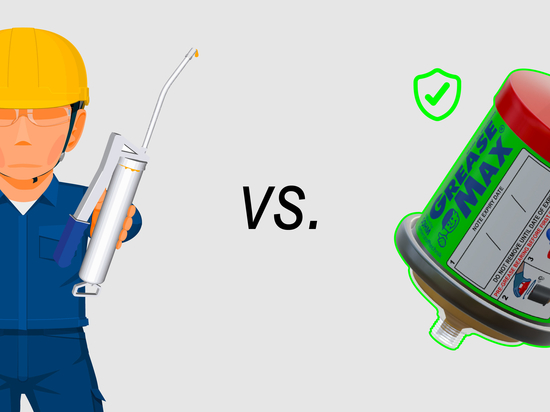
Automatic lubrication replaces time-consuming manual rounds across extensive production lines. The time saved is available for forward-looking maintenance rather than reactive damage repair. In hot, wet, or rotating areas, maintenance personnel need to intervene far less frequently. Lubrication points that were previously only reachable at risk can be safely and automatically supplied via hose lines.
GREASEMAX®: Precise lubrication solution for demanding production conditions
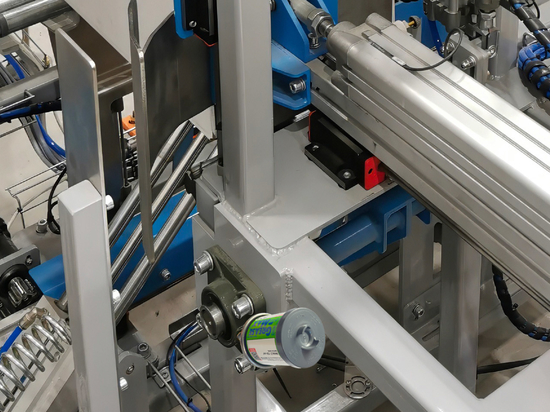
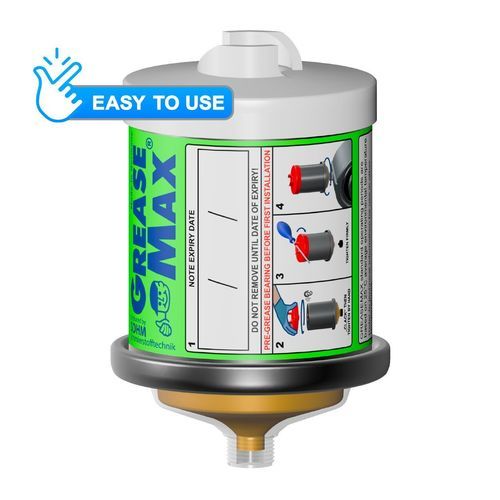
GREASEMAX® is a gas-driven single-point lubricator requiring no electricity, no electronics, and no external control. For use in the pulp and paper industry, it delivers the decisive characteristics: the closed lubrication system protects the lubricant from moisture, aggressive media, and dust ingress, even in wet process zones. Operating periods of 1, 3, 6, or 12 months with consistent, even lubricant delivery make consumption plannable, entirely without electronics and without sensitive mechanical components. The temperature-resistant and vibration-resistant design is engineered for sustained use under temperature fluctuations and high mechanical loads. Flexible mounting directly at the bearing point or via hose connection up to two metres in length makes it possible to supply lubrication points reliably from outside hazardous or hard-to-reach areas. For maintenance personnel, this means no lengthy manual lubrication rounds, no forgotten lubrication points, and considerably fewer interventions in hot, wet, or rotating areas.
Conclusion: Reliable lubrication as the foundation for economical productionFrom pulp production through paper manufacturing to finishing, every process stage benefits measurably from automatic lubrication. Higher availability, plannable maintenance, lower energy consumption, and greater safety for maintenance personnel are not abstract promises but direct consequences of a reliable, continuous lubricant supply. In an industry where every hour of downtime generates high costs, automatic lubrication is not a complex system solution but a robust, easily integrated measure with immediately noticeable effect.