#Industry News
Automatic Lubrication in Wastewater Treatment Plants
Learn how automatic lubricators reduce downtime, optimize maintenance, and improve operational reliability in wastewater treatment plants.
Automatic Lubrication in Wastewater Treatment Plants
Wastewater Treatment Plants: Critical Infrastructure That Must Perform Reliably
Wastewater treatment plants are among the most important infrastructure facilities of our time. They ensure clean water, protect ecosystems, and comply with increasingly stringent environmental regulations. At the same time, they operate under enormous performance pressure: energy efficiency, availability, and cost-effectiveness must be maintained at all times. Pumps, agitators, screening systems, and screw presses must operate reliably around the clock to keep processes running smoothly. Proper lubrication plays a key role in achieving this reliability, and this is precisely where self-contained automatic lubrication systems demonstrate their clear advantages.
Why Equipment in Wastewater Treatment Plants Faces Exceptional Demands
The operating environment in wastewater treatment plants is among the harshest conditions machinery can encounter. Components are continuously exposed to moisture, contamination, aggressive chemicals and sludge, as well as temperature fluctuations and vibration.
Under these conditions, rolling bearings, spindles, and chains quickly lose lubricant. Grease is washed away, lubrication intervals become shorter, or lubrication points are overlooked entirely. This often occurs because many lubrication points are difficult to access or present safety-related challenges. The shortage of skilled maintenance personnel further aggravates the situation. When maintenance resources are limited, routine relubrication becomes an organizational weak point. Automatic lubrication addresses exactly this challenge by protecting components reliably around the clock, regardless of environmental conditions or personnel availability.
Typical Challenges in Wastewater Treatment Plant Operations
Continuous Exposure to Moisture
Constant exposure to water and chemicals promotes corrosion and accelerates lubricant loss at bearing locations that can rarely be relubricated manually at the right time.
Difficult-to-Reach Equipment Areas
Installations located in pits, shafts, underground sections, or above water make manual lubrication time-consuming, complex, and potentially hazardous.
Large Facilities with Numerous Lubrication Points
Extensive plant layouts with a large number of dispersed lubrication points consume valuable labor hours that are often unavailable in facilities operating with limited maintenance resources.
High Costs of Downtime
Inadequate lubrication can lead directly to costly equipment failures. A malfunctioning agitator or an out-of-service press can bring entire process stages to a halt, resulting in costs that extend far beyond the actual repair work.
Where Automatic Lubrication Delivers Measurable Benefits in Wastewater Treatment Plants
Mechanical Treatment
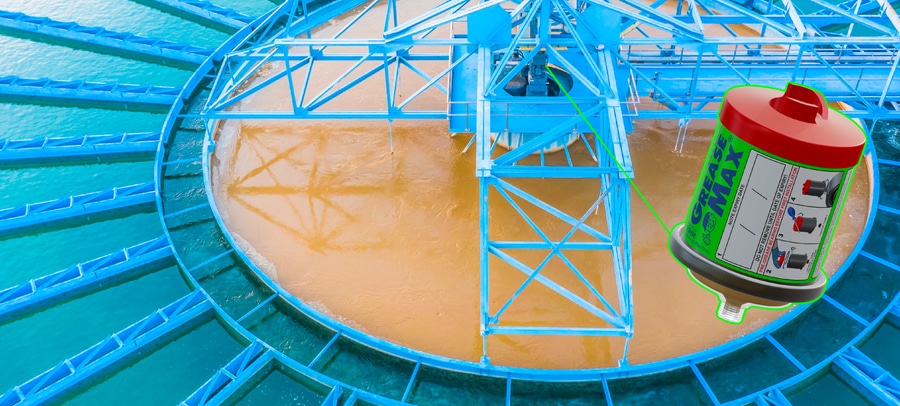
Screening systems, grit removal systems, grease traps, and belt filter presses operate in direct contact with wastewater. Exposure to moisture and abrasive contaminants is extremely high. Automatic lubrication reliably protects bearings and drive systems against water, contamination, and premature corrosion without requiring maintenance personnel to intervene in these demanding areas.
Biological Treatment
Agitators and pumps in aeration basins, membrane bioreactor systems, and secondary clarifiers perform continuous-duty tasks under constant load. A consistent supply of grease ensures smooth operation and prevents failures caused by dry running, even when facilities operate around the clock and manual lubrication rounds are impractical.
Sludge Treatment
Thickeners, digesters, pumps, and screw presses process abrasive and highly viscous materials under heavy operating loads. Automatic lubrication ensures reliable operation and minimizes maintenance requirements even under these extreme conditions, particularly at lubrication points that are often difficult and time-consuming to access manually.
Practical Benefits for Your Wastewater Treatment Facility
Lubrication is performed reliably and consistently, regardless of shift schedules, personnel availability, or the accessibility of lubrication points.
Friction, corrosion, and seal wear are significantly reduced, resulting in a measurable increase in component service life.
Long refill intervals and consistent lubrication performance simplify maintenance planning and make service cycles more predictable.
Eliminating direct contact with hazardous or difficult-to-access machine areas reduces accident risks and significantly simplifies risk assessments.
Well-lubricated bearings operate with lower friction and measurably reduce the load on drive motors. This is an important advantage in facilities where energy efficiency is a constant operational priority.
Modern Challenges Require Modern Solutions
The wastewater treatment industry is undergoing significant change. Skilled labor shortages, increasing documentation requirements, and ongoing cost pressures are forcing operators to make maintenance processes simpler and more efficient.
Automatic lubrication systems meet these requirements precisely. They operate accurately, require minimal maintenance, and function according to predefined lubrication intervals that can be documented automatically. This is a valuable advantage during inspections, audits, and compliance reviews.
GREASEMAX®: A Self-Contained Lubrication Solution for Wet and Aggressive Environments
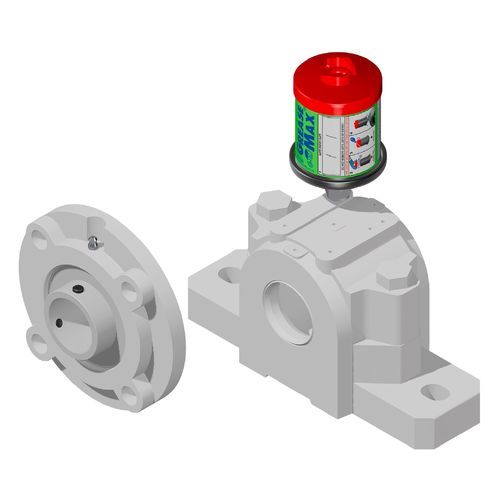
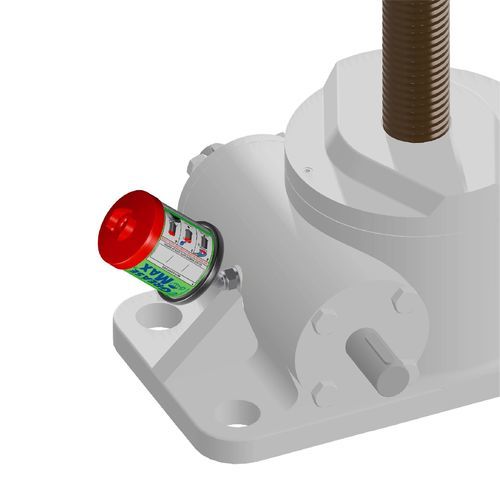
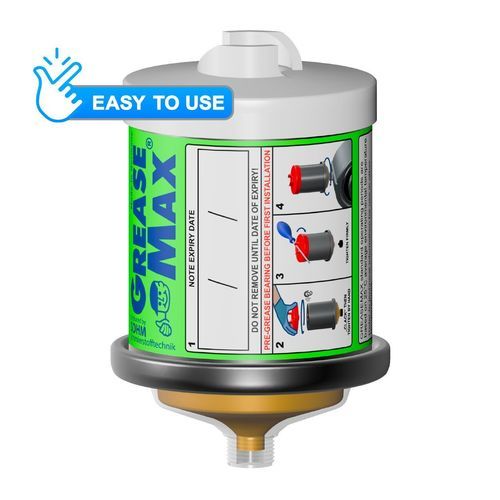
GREASEMAX® is a gas-driven single-point lubricator that requires no power supply, no electronics, and no external control system. For wastewater treatment applications, it offers the exact characteristics required in demanding operating environments.
Its self-contained, completely electronics-free design is ideally suited for wet and aggressive environments. The sealed lubrication system reliably protects the lubricant from moisture, chemicals, and contamination.
Operating periods of 1, 3, 6, or 12 months with a constant and uniform lubricant output make lubrication performance fully predictable and easy to plan.
Thanks to its compact design, GREASEMAX® can be installed directly at the lubrication point or remotely via a hose connection up to two meters in length. This provides maximum flexibility, enhanced safety, and reliable lubrication without requiring additional infrastructure.