#Industry News
Barrel Plating Vs Rack Plating
Barrel Plating Vs Rack Plating
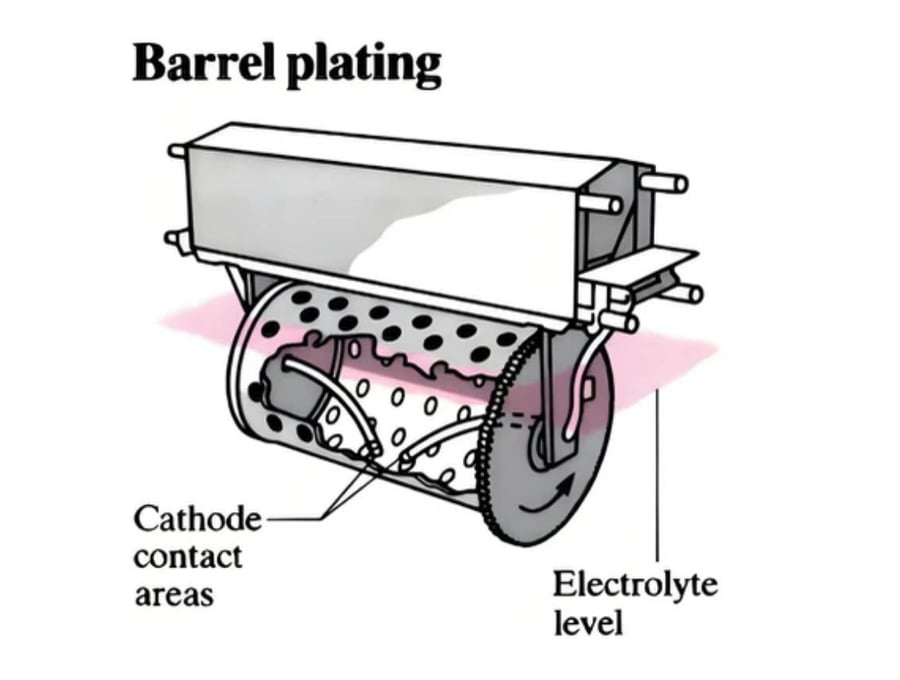
Electroplating is a surface finishing process that deposits a thin metal layer on a part using an electrochemical reaction. Two main techniques are barrel plating and rack plating, which differ mainly in how parts are mounted and handled during plating. Barrel plating involves placing many small parts in a rotating drum, allowing them to tumble and be plated simultaneously. Rack plating, by contrast, involves mounting each part individually on a rack, which remains stationary in the plating tank, allowing for precise control of plating parameters.
Barrel plating is ideal for high-volume, low-cost production of small parts like screws, nuts, and jewelry components. It offers efficient throughput and gentle handling of fragile parts. However, it is less suitable for precision applications or parts with complex geometries, as it can lead to uneven coating and a higher risk of scratches or deformation. Additionally, process monitoring is more difficult with bulk loads, increasing the chance of undetected defects.
Rack plating excels in precision and customization, making it suitable for complex-shaped parts, such as medical components or electronics. Each part is fixed and processed individually, allowing for consistent coating quality and easier quality control. However, it is more labor-intensive, slower, and costlier, making it less ideal for mass production of simple parts.
Choosing between the two methods depends on part complexity, production volume, and quality requirements. Barrel plating is recommended for simple, high-volume components, while rack plating is preferred for detailed, high-precision parts. Manufacturers like HLC offer tailored electroplating solutions, helping businesses select the optimal method to balance cost, efficiency, and quality.