#Industry News
Metal Bending 101: A Guide To Precision Sheet Bending
Metal Bending 101
What Is Metal Bending and How It Works
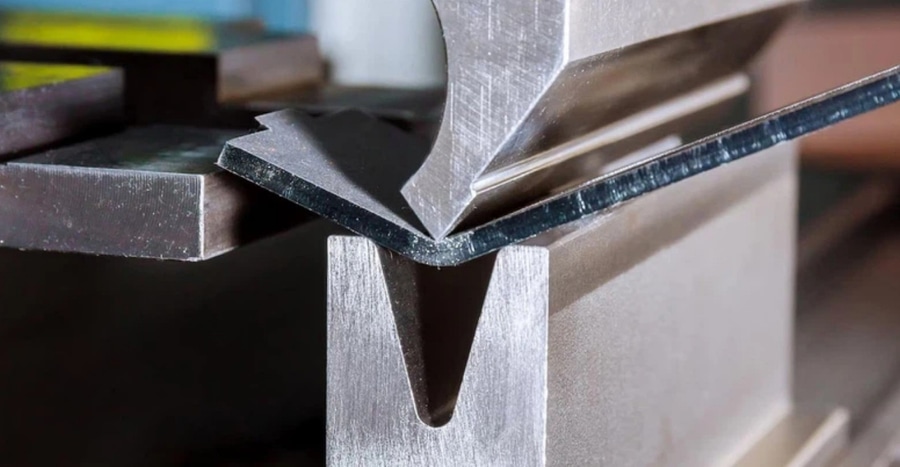
Metal bending is a cold-forming manufacturing process used to deform sheet metal into specific angles, curves, or complex shapes without cutting or welding. The process involves placing a flat metal blank between a punch and die, then applying force to bend the material. Key factors include planning bend lines, allowing for springback, and selecting the right tooling and machine setup. Depending on the thickness, material properties, and complexity of the part, bending can be done using various techniques such as air bending, bottoming, and coining, each offering different levels of force, accuracy, and flexibility.
Bending Methods, Forms, and Materials
There are numerous bending techniques tailored to different use cases. These include rotary draw bending for tubes, roll bending for large-radius curves, folding for panel edges, and elastomer bending for pre-coated materials. In terms of forms, common types include V-bends, U-bends, Z-bends, curls, hems, and joggles. Suitable materials range from mild steel, stainless steel, and aluminum to copper, brass, and coated steels. Material ductility, thickness, grain direction, and heat treatment all influence bendability and must be considered during design and fabrication.
Design, Tools, and Common Defects
Designing for bendability involves applying best practices such as maintaining minimum flange lengths, proper hole placement, accounting for springback, and aligning bend lines. Tools like press brakes, folding machines, roll benders, and rotary dies support different types of bending operations. Common bending defects include springback deviation, cracking, wrinkling, twist, tooling marks, and distortion around holes. Many of these issues can be avoided with good design, proper tooling, and material selection.
Applications, Cost Factors, and Practical Insights
Metal bending is widely used in manufacturing enclosures, brackets, trays, chassis, appliance housings, and architectural panels. It offers benefits such as structural integrity, efficient material use, and integration with other fabrication steps. While not expensive per part, costs are influenced by material type, bend complexity, tolerance requirements, and volume. Compared to stamping or die casting, bending provides flexibility and low tooling costs for medium and low volumes. A properly bent metal part can last for decades with minimal maintenance, making metal bending a core process in precision sheet metal fabrication.