#Industry News
Nylon Vs Polyamide: Are They The Same? A Complete Guide
Nylon Vs Polyamide
1. Definitions and Structures
Polyamide is a family of polymers containing repeating amide bonds in their backbone, which can be natural (like wool and silk) or synthetic. Nylon, a specific subgroup of synthetic polyamides first developed by DuPont in the 1930s, falls within this family. Not all polyamides are nylons. Polyamides are further categorized as aliphatic (nylon 6, nylon 66), semi-aromatic (PPA), aromatic (aramids like Kevlar® and Nomex®), and polyimides, each offering unique performance levels.
2. Types and Properties
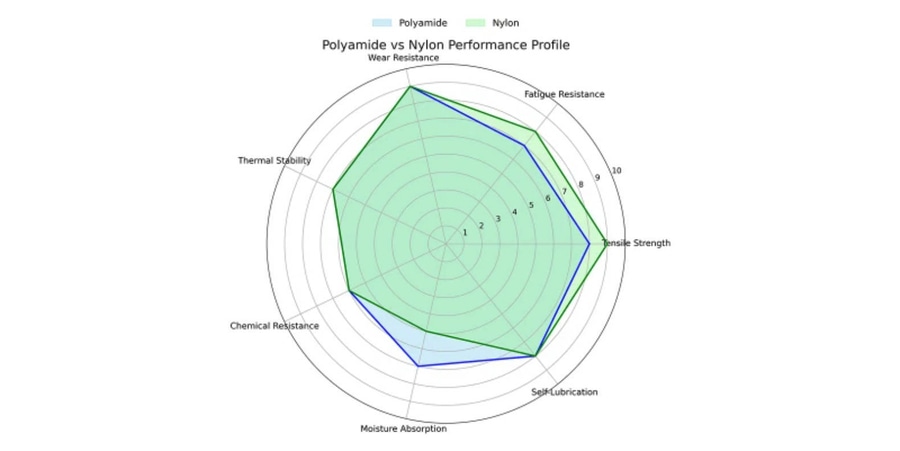
Nylons are classified by numbers that represent their monomer composition, such as Nylon 6 (from caprolactam) and Nylon 66 (from hexamethylenediamine and adipic acid). These materials are valued for their strength, abrasion resistance, fatigue resistance, and thermal stability, though they are moisture-absorbing and require pre-drying before processing. High-performance polyamides like aramids and PPAs exhibit even greater strength, rigidity, and heat resistance, making them suitable for demanding environments.
3. Applications and Manufacturing
Polyamides and nylons are widely used in automotive, electronics, industrial equipment, textiles, and consumer goods. Everyday products often use nylon grades, while advanced polyamides are essential in aerospace, electrical insulation, and high-heat environments. Manufacturing processes include condensation polymerization (nylon 66, PPA) or ring-opening polymerization (nylon 6, nylon 12). Performance is tailored with additives such as glass fiber, flame retardants, or stabilizers.
4. Comparisons and Conclusions
Nylon is a commercialized subset of polyamide prized for its balance of cost, strength, and versatility. Other polyamides offer a broader performance range, from flexible copolyamides to ultra-strong aramids. Compared with polyester, polyamides are stronger and more heat resistant but absorb more moisture, while polyester is cheaper and more UV resistant. Selection depends on the application's mechanical, thermal, moisture, and cost needs.