#Industry News
Plastic Extrusion: Process, Types, Materials & Applications
Plastic Extrusion
1. Introduction to Plastic Extrusion
Plastic extrusion is introduced as a high-volume manufacturing process where raw plastic, typically in the form of pellets or powder, is melted and pushed through a shaped die to create continuous profiles. These profiles can be pipes, sheets, films, or other custom shapes. The article emphasizes that extrusion is ideal for producing large quantities of uniform products at relatively low cost.
2. Key Components and Pre-Processing
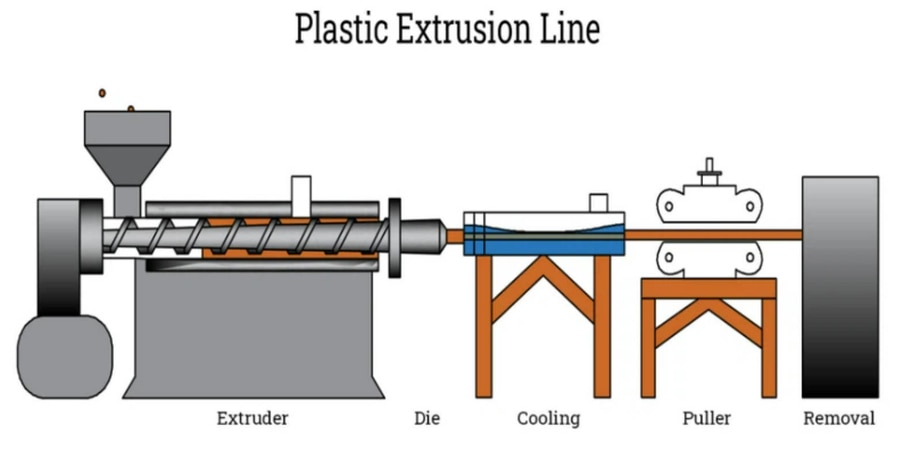
Before extrusion begins, raw materials often require preparation such as drying, mixing with colorants or additives, and removing contaminants. The extrusion line itself includes a hopper, feed section, screw and barrel, die, and downstream equipment like cooling baths, cutting units, or winding systems. Each stage plays a critical role in ensuring consistent product quality and production efficiency.
3. Extruder Types and Process Variants
The article explains different extruder types, such as single-screw and twin-screw extruders, as well as specialized systems like ram extruders or vented machines. Each has strengths in mixing ability, processing sensitive materials, and production speed. It also highlights the main extrusion methods: tubing extrusion, blow film extrusion, sheet/film extrusion, and over-jacketing (commonly used for wire and cable insulation).
4. Material Selection and Properties
Choosing the right plastic is essential for performance and cost. Factors include mechanical strength, thermal behavior, chemical resistance, melt viscosity, and compliance with safety standards. Common plastics for extrusion include polyethylene (PE), polypropylene (PP), polyvinyl chloride (PVC), polystyrene (PS), ABS, polycarbonate (PC), PETG, nylon (PA), and thermoplastic elastomers (TPE/TPU). Each offers distinct advantages in flexibility, durability, or transparency.
5. Benefits, Challenges, and Applications
Plastic extrusion offers advantages such as high efficiency, design flexibility, low tooling cost, and compatibility with additives. Challenges include die swell, uneven cooling, surface defects, and potential material degradation from poor process control. The applications are broad, spanning construction (pipes, window profiles), packaging (films, bags), automotive (seals, trims), medical (catheters, tubing), and consumer goods. Future trends include sustainable materials, advanced co-extrusion, AI-based process monitoring, and automation for better quality and efficiency.