#Industry News
3D Printing Vs Injection Molding: A Complete Comparison
3D Printing Vs Injection Molding
1. Definition & Purpose
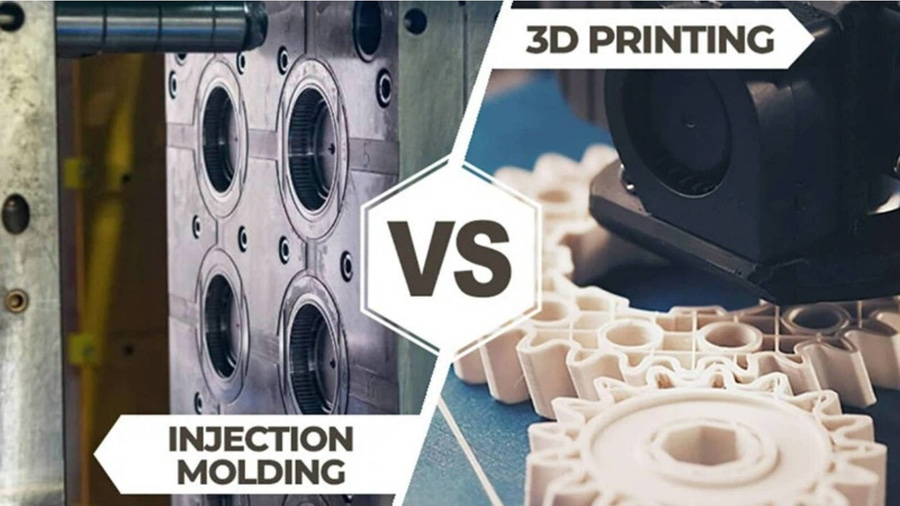
The article begins by defining the two manufacturing processes: 3D printing (additive manufacturing) builds parts layer by layer from a digital model, whereas injection molding (a formative process) forces molten plastic into a mold under pressure to produce parts. It positions 3D printing as ideal for prototypes, complex geometry, and low-volume runs, while injection molding is best for mass production, consistent quality, and durability.
2. Technologies & Variants
It describes the common 3D printing technologies—FDM (melting and depositing filament), SLA/DLP (curing resin with light), and SLS (sintering powdered polymer with lasers) —each having different strengths in detail, support structure requirements, and material options.
Similarly, the article covers different types of injection molding: thermoplastic, thermoset, overmolding, insert molding, micro injection molding, and gas-assisted molding—each suited to particular materials, geometries, or functional requirements.
3. Pros and Cons Comparison
The article lays out advantages and disadvantages of both methods. For 3D printing: low upfront cost (no tooling), fast prototyping, flexibility for custom/complex shapes, and minimal waste—but slower per part, limited material options, weaker mechanical properties, and rougher surfaces.
For injection molding: strong, consistent parts with tight tolerances, broad material choices, and low per-unit cost at scale—but high upfront tooling cost, less flexibility for design changes, and long lead time before production begins.
4. Material, Design, and Performance Differences
On materials: injection molding supports a far wider variety of plastics and additives, while 3D printing is more limited (e.g. PLA, ABS, resin, nylon).
In terms of design complexity, 3D printing excels in allowing internal channels, organic shapes, lattice structures, and undercuts without needing complex tooling, while injection molding is constrained by draft angles, wall thickness, and molding feasibility.
Performance-wise, injection molded parts tend to have isotropic mechanical properties and higher strength, whereas 3D printed parts often suffer from anisotropy (weaker between layers) and may require post-processing (annealing, infiltration) to improve strength.
5. Cost, Lead Time, Applications & Outlook
Regarding time and cost: 3D printing has minimal startup costs and fast lead times, but higher cost per unit; injection molding demands significant tooling investment and longer setup, but then yields very fast cycle times and low per-part costs.
On environmental impact: 3D printing generates less waste (because it only uses needed material) but can be energy-intensive; injection molding produces sprues, runners, and scrap (though some can be recycled), but becomes very efficient at scale.
The article offers guidance: use 3D printing when you need rapid prototyping, complex/custom parts, or small batches; use injection molding when you’re scaling to high volumes, require strong, repeatable parts with tight tolerances.
Finally, it discusses future trends: 3D printing advancing toward higher speed, better materials, multi-material printing, and production use; injection molding evolving through automation, hybrid processes (combining printing + molding), faster tooling, and digital integration.