#Industry News
Blow Molding 101: Everything You Need To Know
Blow Molding 101
1. Definition and Purpose
Blow molding is a plastic manufacturing method for creating hollow parts by inflating heated plastic (a parison or preform) inside a mold until it conforms to the cavity shape.
It’s especially suited for producing lightweight, hollow products like bottles, containers, and tanks, with efficient material use and relatively low finishing needs.
2. Historical Background
The concept of blow molding evolved from the glass-blowing tradition: the idea of inflating a hot material into a cavity was transferred to plastics in the 20th century.
The first commercial plastic blow molding machines appeared in the 1930s, and the technique expanded in the following decades as synthetic polymers like polyethylene became widespread.
Innovations such as extrusion blow molding, injection blow molding, and stretch blow molding in the 1970s–80s further diversified application areas (e.g. PET bottles).
3. Process Steps: From Melt to Finished Part
The article outlines the key stages in blow molding:
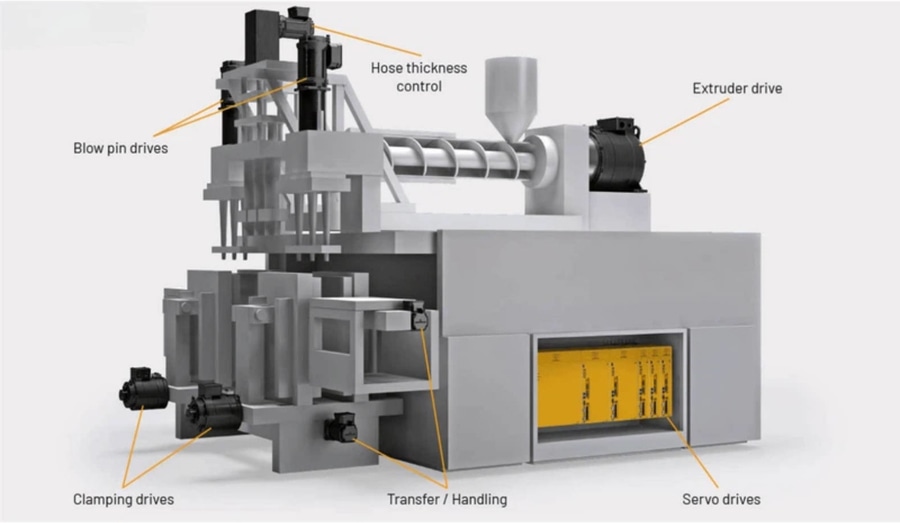
Plastic Preparation: Resin pellets are melted in an extruder, with careful temperature control to avoid degradation.
Parison / Preform Formation: Depending on the method, a parison (molten tube) or a preformed shape is produced.
Mold Closing & Inflation: The mold clamps around the parison, and compressed air is used to expand it to fit the mold walls. In stretch blow molding, the preform is also mechanically stretched before inflation for better properties.
Cooling & Ejection: The plastic solidifies against the mold, the mold opens, and the part is ejected. Excess material is trimmed.
4. Main Types of Blow Molding
The article describes several variants, each suited to different product types:
Extrusion Blow Molding (EBM): A parison is extruded, then inflated in a mold. Good for medium to large hollow products with flexibility in wall thickness.
Injection Blow Molding (IBM): First, a preform is injection molded, then transferred and inflated. Offers excellent dimensional control and surface finish, often used for small bottles, vials.
Injection Stretch Blow Molding (ISBM / SBM): The preform is stretched mechanically and then blown, resulting in biaxial orientation, improving strength, clarity, and barrier properties (commonly used for PET beverage bottles).
Co-extrusion Blow Molding: Multiple extruders produce a layered parison (e.g. barrier layers or reinforcements). Used when combining functions (e.g. chemical resistance, structural strength).
Rotary Wheel Blow Molding: High throughput method with multiple molds on a rotating wheel, passing through extrusion, inflation, cooling, and ejection in sequence.
Extrusion Stretch Blow Molding: A hybrid of extrusion + stretching, used for specialty parts needing strength with minimal material.
5. Materials Suitable for Blow Molding
Blow molding accommodates a variety of thermoplastics, but some are more common:
HDPE (High-Density Polyethylene) is the most used, thanks to its toughness, chemical resistance, light weight, and suitability for food contact.
LDPE, LLDPE: More flexible, useful for thinner walls, squeeze bottles, etc.
PP (Polypropylene): Offers rigidity and heat/chemical resistance, useful in medical, food, and automotive contexts.
PET: Excellent clarity and barrier properties; often used in stretch blow molding for beverage bottles.
Others: PVC, PS, ABS, PC, and recycled/regrind resins also see use.
6. Cost Structure, Advantages & Limitations
Cost & economics: Tooling costs in blow molding are generally lower than in injection molding for medium and large hollow parts, making blow molding economically favorable at moderate to high volumes.
However, for very low volumes, other prototyping methods may be cheaper; for high precision solid parts, injection molding may be more economical in the long run.
Advantages: High production efficiency (fast cycles), design flexibility (handles, complex curves, integrated features), lightweight parts, good material utilization, consistency in high-volume runs.
Challenges / Defects: Issues include uneven wall thickness (due to parison control or cooling imbalance), flash (excess material at seams), bubbles/voids (from moisture or trapped air), surface defects (from temperature instability or contamination).
7. Applications & Comparisons with Other Molding Methods
Applications: Blow molding is heavily used for beverage bottles, detergents, shampoo bottles, home-care containers, automotive parts (fuel tanks, reservoir systems), industrial drums and tanks, medical/vial containers, consumer goods (toys, reusable bottles).
Vs Rotational Molding: Blow molding is faster, better suited for higher volumes, lower per-part cost for hollow parts with thinner walls; rotational molding handles thicker walls, large simple shapes, and lower tooling investments but slower cycles.
Vs Injection Molding: Blow molding is optimized for hollow parts; injection molding is better for solid or more intricate parts with tight tolerances.
8. Integration, Sustainability & Future Directions
Integration with 3D Printing: 3D printing is useful in the design and development stages, for prototyping containers, test molds or inserts, iterating features before committing to full blow molding tooling.
This reduces risk and cost in the early development phase.
Sustainability Trends: The industry is adapting via use of recycled materials (post-consumer or industrial regrinds), adoption of bio-based and biodegradable plastics (e.g. bio-PET, PLA), lightweighting (thinner walls without sacrificing strength), energy efficiency improvements (electric drives, better heating/cooling), and closed-loop recycling of flash/scrap.
Conclusion: Blow molding remains a highly efficient, flexible, and cost-effective method for producing hollow plastic parts across many industries. Its future will likely emphasize sustainability, integration with digital manufacturing, and advanced materials to stay competitive.