#Industry News
Centrifugal Casting: Process, Types, Materials, And Applications
Centrifugal Casting
1. Overview and Principle
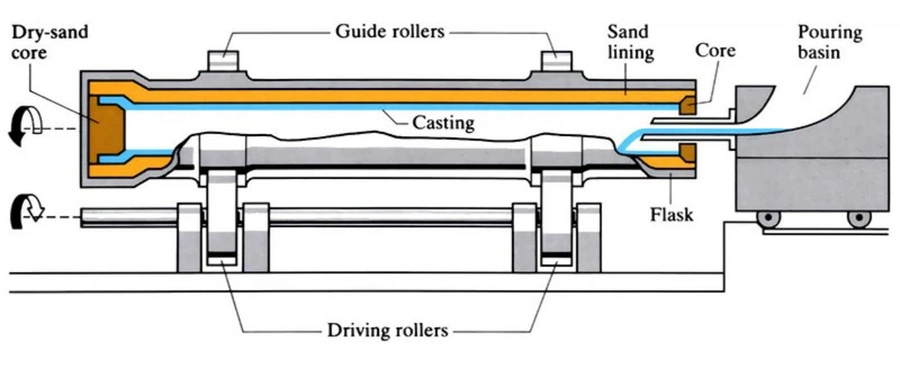
Centrifugal casting is a manufacturing process that uses centrifugal force to form metal or plastic parts. Molten material is poured into a rapidly rotating mold, and the force pushes the metal outward against the mold walls. This creates a dense, uniform structure with minimal impurities. The method is widely used for cylindrical or hollow parts because it naturally removes gas porosity and inclusions, resulting in high-quality castings.
2. Process Steps
The process begins with mold preparation and preheating to ensure smooth metal flow. Once the mold reaches the desired temperature, molten metal is poured while the mold spins at high speed. The centrifugal force distributes the metal evenly along the mold walls. The casting solidifies from the outer surface inward, producing a fine-grained outer layer and allowing lighter impurities to collect on the inner surface. After cooling, the mold is stopped, and the part is removed for machining or finishing.
3. Types of Centrifugal Casting
The main types include true centrifugal casting, semi-centrifugal casting, and centrifugal investment casting. In true centrifugal casting, hollow cylindrical parts such as pipes or rings are formed without a core. Semi-centrifugal casting applies the same principle but is used for solid shapes like wheel hubs. Centrifugal investment casting uses multiple molds arranged around a rotating axis, ideal for smaller, intricate components. Depending on the orientation, the process can be horizontal (for long parts) or vertical (for shorter parts).
4. Materials and Characteristics
Centrifugal casting works well with a variety of metals and alloys, including stainless steel, carbon steel, cast iron, copper alloys, aluminum, and nickel-based alloys. The resulting parts feature high density, smooth surfaces, excellent mechanical strength, and superior grain structure compared to other casting methods. Because no cores are needed, the process minimizes defects and improves material yield. However, it requires precise control of rotational speed, pouring temperature, and cooling rate to maintain dimensional accuracy.
5. Applications, Advantages, and Limitations
This method is commonly used to produce pipes, bushings, bearings, flywheels, turbine rings, and other rotationally symmetric components in automotive, aerospace, and industrial machinery sectors. Key advantages include high material utilization, defect-free parts, and good mechanical integrity. Limitations include difficulty in creating complex geometries, the need for specialized equipment, and post-machining for inner surfaces. Overall, centrifugal casting is valued for combining quality, strength, and efficiency in producing hollow and round components.