#Industry News
30+ Types Of Sensors You Need To Know
30+ Types Of Sensors You Need To Know
1. Definition and Role of Sensors
Sensors are devices that detect physical changes in the environment—such as temperature, light, pressure, or motion—and convert them into measurable electrical signals. They act as the bridge between the physical and digital worlds, enabling smart systems, robots, and industrial equipment to “perceive” their surroundings and respond intelligently.
2. Working Principle and Signal Processing
The basic operation of a sensor involves a sensing element that reacts to a physical input, a transducer that converts this input into an electrical signal (such as voltage or current), and a signal-conditioning circuit that amplifies, filters, and transmits the data to a controller. This signal chain transforms raw environmental changes into useful digital information.
3. Key Performance Metrics
When selecting a sensor, engineers evaluate critical specifications such as accuracy, sensitivity, range, response time, repeatability, stability, linearity, and durability under different environmental conditions. These parameters determine how reliable and consistent the sensor’s output will be in real-world applications.
4. Types of Sensors by Measured Quantity (Part 1)
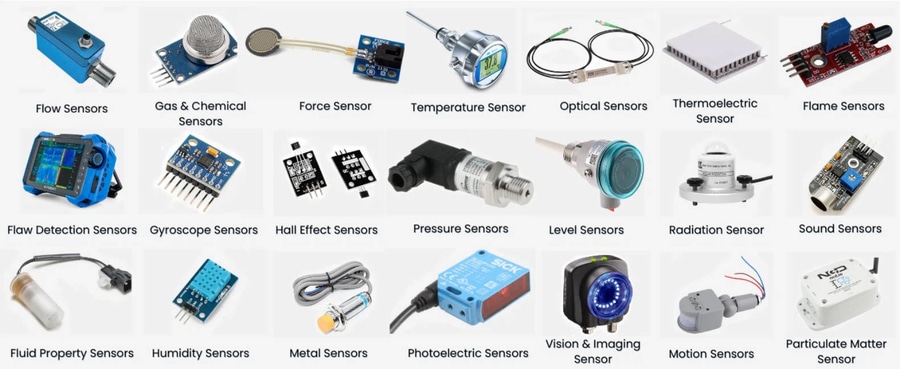
The article lists over 30 sensor types, beginning with those that measure physical quantities. Examples include temperature sensors (thermocouples, RTDs, thermistors, infrared), pressure sensors (using strain gauges or diaphragms), level sensors (float, ultrasonic, radar, capacitive), and flow sensors (turbine, electromagnetic, ultrasonic). Each type serves specific industrial, automotive, or environmental monitoring needs.
5. Types of Sensors by Measured Quantity (Part 2)
Further categories include force and torque sensors for mechanical load measurement, vision and image sensors (CCD/CMOS) for object recognition, position and displacement sensors (encoders, potentiometers, Hall sensors), optical and photoelectric sensors for object detection, motion and vibration sensors (accelerometers, PIR), sound and ultrasonic sensors for acoustic applications, gas and chemical sensors for detecting volatile compounds, and humidity sensors for atmospheric moisture measurement. The article also mentions radiation, flame, defect-detection, metal-detection, leak-detection, gyroscope, and biosensors as specialized classes used across industries from aerospace to healthcare.
6. Classification by Operating Principle
Sensors can also be classified by their physical principle of operation: resistive (detecting resistance change), capacitive (change in capacitance due to distance or dielectric), inductive and electromagnetic (magnetic field interaction), Hall-effect (voltage generated in a magnetic field), piezoelectric (electric charge from applied pressure), optical (light transmission or reflection), thermoelectric (voltage generated by temperature differences), and electrochemical (chemical reactions producing electrical signals). Each principle defines how the sensor interacts with its environment and what materials it requires.
7. Classification by Output Type
Based on the output signal, sensors are divided into analog and digital categories. Analog sensors produce continuously variable signals proportional to the measured quantity, such as voltage or resistance. Digital sensors, on the other hand, provide discrete signals or encoded data, often integrating an internal ADC (analog-to-digital converter) or using protocols like I²C, SPI, or UART, making them more compatible with microcontrollers and IoT devices.
8. Classification by Contact Method
Sensors are also categorized by whether they physically touch the target object. Contact sensors—such as thermistors or strain gauges—offer high accuracy but may wear out or interfere with the measurement object. Non-contact sensors—like infrared, ultrasonic, or radar—enable remote detection, faster response, and longer service life, though they can be affected by dust, temperature, or environmental noise.
9. Practical Selection and Integration Considerations
No single classification system covers all sensors, so the article recommends evaluating multiple dimensions—measured quantity, working principle, signal type, and contact method—together. Engineers should also consider cost, required precision, environmental conditions, installation constraints, and integration with electronics or automation systems when selecting the right sensor for a project.
10. Conclusion and Industrial Relevance
The article concludes that understanding different sensor types and principles is essential for building accurate and reliable systems in manufacturing, automotive, robotics, and IoT applications. HLC Metal Parts emphasizes its capability to support sensor projects through custom metal and plastic components, contact assemblies, housings, and automated assembly solutions, ensuring both precision and durability in sensor production.