#Industry News
All About Lost Foam Casting
All About Lost Foam Casting
1. Definition & Process Principle
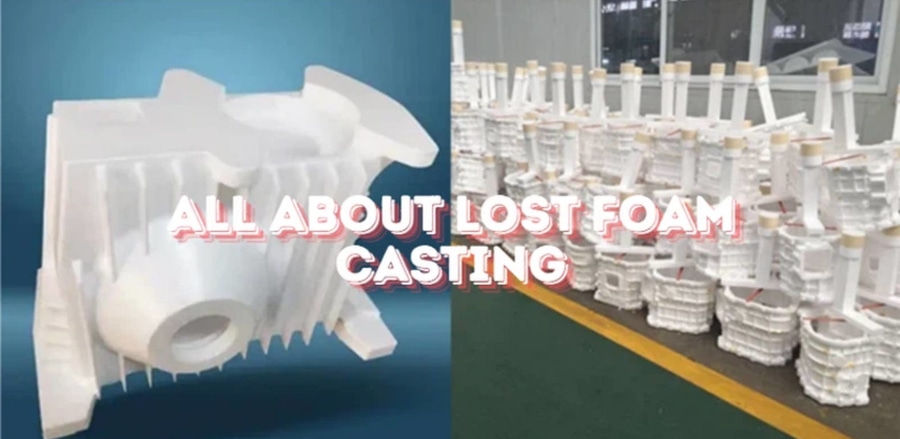
Lost foam casting is a metal-casting method in which a pattern made from expanded polystyrene (EPS) foam is coated with a refractory material and then directly surrounded by unbound sand. When molten metal is poured in, the foam pattern vaporizes and the metal fills the cavity in place of the foam, forming the finished casting.
This technique enables production of intricate, coreless castings with complex internal geometries and thin walls.
2. Historical Development & Pattern-making
The method originated in the late 1950s with the patenting of foam-pattern casting by H. F. Shroyer.
Foam patterns are made by injection-molding foam beads, machining, or 3D printing for lower volumes. They are then coated with a refractory slurry, placed in a flask, filled with sand, and compacted before pouring.
3. Materials and Suitable Metals
Lost foam casting supports a wide array of metals—both ferrous and non-ferrous. Typical materials include aluminum alloys, cast irons, steels, stainless steels, copper alloys, and magnesium.
Because the foam pattern allows elimination of cores and parting lines, the process offers design freedom, with parts that have smooth surfaces and fine detail.
4. Advantages & Limitations
Advantages of lost foam casting include high dimensional accuracy, excellent surface finish (for a sand-based mold process), minimal waste (since foam replaces many gating/riser systems), and reduced need for cores and parting lines.
Limitations include the cost of foam pattern production (especially for small batches), the requirement for careful sand compaction and coating control to avoid defects, and challenges with very large parts or heavy walls where foam deformation or inadequate gas evacuation may occur.
5. Applications & Comparison with Other Casting Methods
Common applications include engine blocks, cylinder heads, pump housings, valve bodies, brackets, and large structural castings where complex shapes and near-net-shape production are beneficial.
Compared to traditional sand casting, this process offers better accuracy and surface finish; compared to investment (lost-wax) casting, it offers lower tooling cost and simpler process for medium-to-large parts. It thus represents a middle ground between cost and precision.