#Industry News
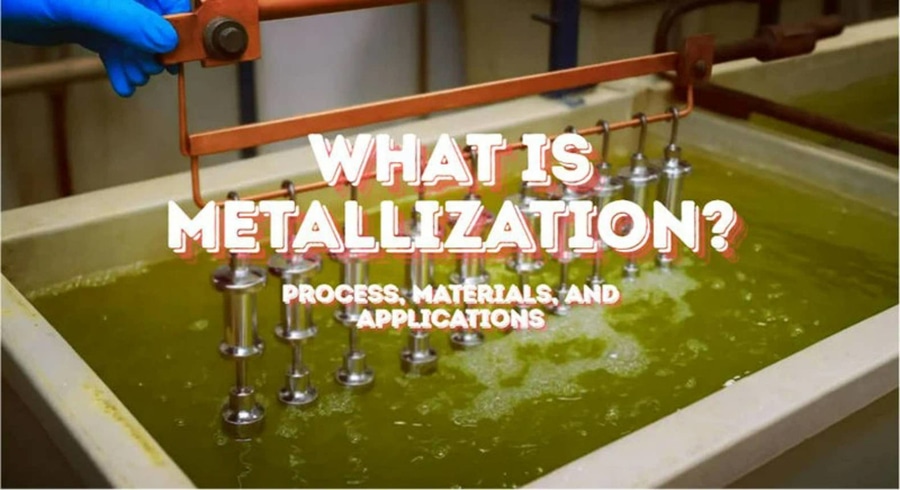
What Is Metallization? Process, Materials, And Applications
What Is Metallization?
1. What Is Metallization
Metallization is a process that applies a thin layer of metal onto the surface of another object — which may be metal or non-metal (plastic, ceramic, glass, etc.).
The resulting metal coating can serve decorative, protective, or functional purposes (for example, improving corrosion resistance, wear resistance, electrical conductivity, appearance, or durability).
2. Main Metallization Methods
There are several common methods of metallization:
Thermal spray / metal-spray coating — molten (or semi-molten) metal (often powder or wire) is sprayed onto a prepared surface, forming a adherent metallic layer.
Vacuum (or vapor) metallizing — metal is vaporized in a vacuum chamber, then condenses on the surface of the substrate to form a uniform thin film.
Electroplating / electroless plating — metal ions (e.g. copper, nickel, etc.) are deposited onto a conductive surface via electrical current (electroplating) or chemical reaction (electroless plating), suitable for many metals and substrate types.
Each method has trade-offs in terms of coating thickness, adhesion, required surface preparation, suitability for substrate material, and performance characteristics.
3. What Metallization Adds: Benefits
By metallizing a part, you can significantly enhance its performance or appearance. Benefits include: improved corrosion resistance and wear resistance (especially important for parts exposed to harsh environments) ; increased surface hardness or durability; enhanced electrical or thermal conductivity when needed (for electronics, sensors, shielding, etc.)
and a metallic appearance — useful for decorative or premium-looking consumer products (e.g. plastic parts that look like metal).
Furthermore, compared with simple paint or non-metal coatings, metallization tends to offer stronger adhesion, less peeling or flaking, and more long-term durability under mechanical or environmental stress.
4. Substrates & Applications
Metallization is versatile: coatings can be applied on metals, plastics, ceramics, glass, composites — as long as the substrate is properly pre-treated (cleaned, maybe roughened or activated) to ensure adhesion.
Common applications span many industries: automotive (decorative trims, structural parts, corrosion-protected parts), electronics (conductive or shielded housings), consumer goods (plastic products with metal finish), industrial machinery (wear-resistant surfaces, protective coatings), and packaging or decorative surfaces (e.g. metalized plastics for visual appeal).
5. Considerations and Limitations
Although metallization offers many advantages, there are some trade-offs and requirements. Surface preparation is critical — the substrate must be cleaned, often roughened, or activated to allow proper bonding of the metal layer; poor prep can lead to weak adhesion or coating failure.
Also, achieving uniform coating on complex geometries or deeply recessed areas can be challenging. Some metallization methods (e.g. thermal spray) produce coatings with some porosity, which may not be ideal for high-precision sealing surfaces unless subsequent machining or sealing is performed.
Finally, while metallization can approximate metal appearance and many mechanical/functional benefits, for very heavy loads or structural requirements, the underlying substrate and overall design must still meet load-bearing requirements — coating alone cannot replace a fully metallic structure in some cases.