#Industry News
Step Turning Vs. Taper Turning: Everything You Need To Know
Step Turning Vs. Taper Turning
1. Overview of Turning Operations
Turning is a machining process used to create rotationally symmetric parts by removing material from a rotating workpiece. Among turning operations, step turning and taper turning serve different geometric and functional purposes. Step turning produces distinct diameter changes along a shaft, while taper turning creates a gradual, angled transition between diameters. Understanding these differences is essential for selecting the correct machining method based on part design, accuracy requirements, and production efficiency.
2. Step Turning: Definition and Process
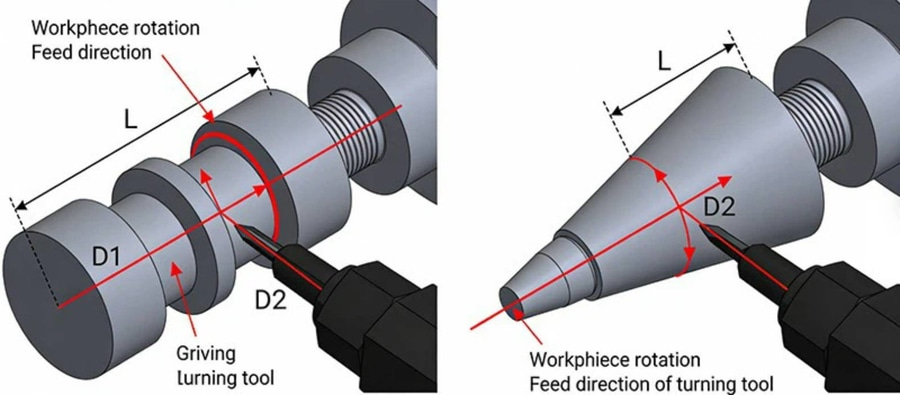
Step turning is used to manufacture shafts with multiple cylindrical sections of different diameters arranged along the same axis. Each section maintains a constant diameter, and transitions are typically sharp shoulders or small fillets. The cutting tool moves parallel to the workpiece axis, machining one step at a time. This method is straightforward, highly repeatable, and well suited to both manual and CNC lathes, especially for batch production of parts with clear dimensional breaks.
3. Taper Turning: Definition and Process
Taper turning creates a workpiece whose diameter gradually increases or decreases along its length, forming a conical or inclined surface. Unlike step turning, the tool follows an angled path relative to the workpiece axis. This can be achieved through compound rest adjustment, tailstock offset, taper attachments, or CNC-controlled tool paths. Taper turning can produce external or internal tapers, as well as uniform or variable taper profiles, making it essential for alignment and mating features.
4. Key Differences in Geometry, Accuracy, and Complexity
The primary difference lies in geometry: step turning results in abrupt diameter changes, while taper turning produces smooth, continuous transitions. Step turning is generally simpler to execute and program, offering high dimensional accuracy because each feature is machined independently. Taper turning requires more precise angle control and machine calibration, making it more sensitive to setup or programming errors. However, taper turning often yields smoother visual transitions and improved functional performance in load or alignment applications.
5. Applications and CNC Manufacturing Considerations
Both processes are widely used across industries such as automotive, aerospace, hydraulics, and industrial machinery. Step turning is commonly applied to shafts, axles, and components requiring bearing seats or mounting shoulders. Taper turning is critical for tool holders, spindle interfaces, press-fit connections, and alignment features. Modern CNC technology allows step turning and taper turning to be combined in a single setup, improving efficiency and consistency while meeting complex design requirements.