#Industry News
Salt Spray Testing | A Comprehensive Guide
Salt Spray Testing
1. What Salt Spray Testing Is
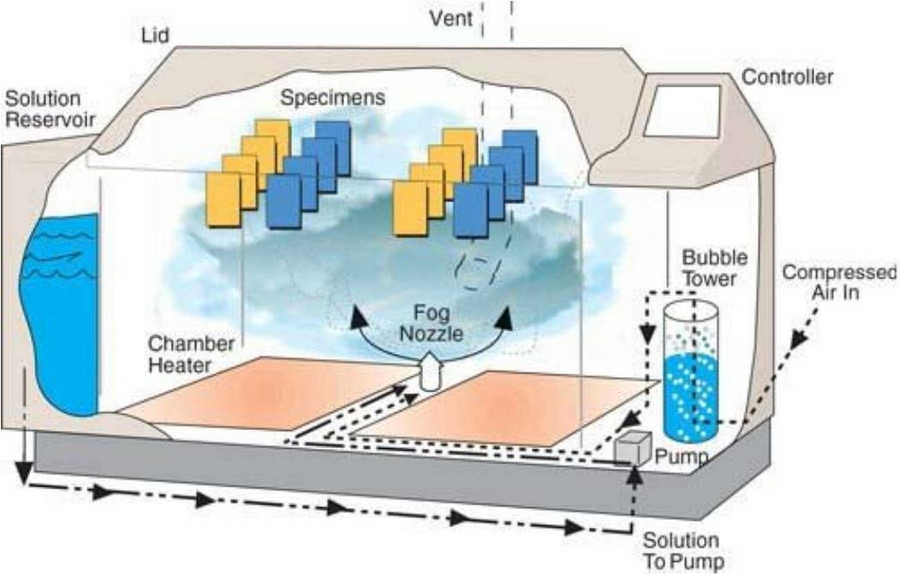
Salt spray testing, also called salt fog or salt corrosion testing, is a standardized method used to evaluate the corrosion resistance of materials and protective coatings, especially metals. It creates an artificially corrosive environment in a controlled chamber filled with fine salt spray to accelerate corrosion and assess how well a material or coating withstands such conditions. This helps manufacturers compare corrosion performance and ensure product durability.
2. How the Test Works
In a salt spray test, cleaned samples are placed inside a test chamber where a saline solution of specific concentration is atomized as a mist over them. The test proceeds for a predetermined duration—commonly from 24 hours up to several hundred or even thousands of hours—depending on standards and test requirements. After exposure, samples are examined for signs of corrosion, and the extent of corrosion determines whether the material passes or fails the test.
3. Standards and Exposure Durations
Salt spray tests follow international standards such as ASTM B117, ISO 9227, ASTM G85, DIN EN ISO 9227, and JIS Z 2371, which define test procedures, chamber conditions, and durations. These standards are widely recognized across industries like automotive, aerospace, coating, and metal finishing to ensure uniformity and comparability of corrosion resistance results. Test exposure times vary by standard and product requirements but typically range from 24 to over 2000 hours.
4. Types of Salt Spray Tests
Different variations of salt spray testing simulate different corrosive environments. The basic neutral salt spray test assesses general corrosion resistance, while modified tests—such as acetic acid salt spray, cyclic corrosion testing, and sulfur dioxide or UV-combined tests—create more aggressive or realistic conditions to evaluate specific coating behaviors. These variations help match testing to real-world environments products might encounter.
5. Importance and Limitations
Salt spray testing is important for quality control, coating selection, and material comparison under accelerated corrosive conditions. It helps manufacturers verify that products and coatings will meet performance expectations in harsh environments like marine, outdoor, or industrial settings. However, it does not perfectly mimic natural corrosion processes, so results are most useful for comparative evaluation rather than exact prediction of real-world lifespan.