#Industry News
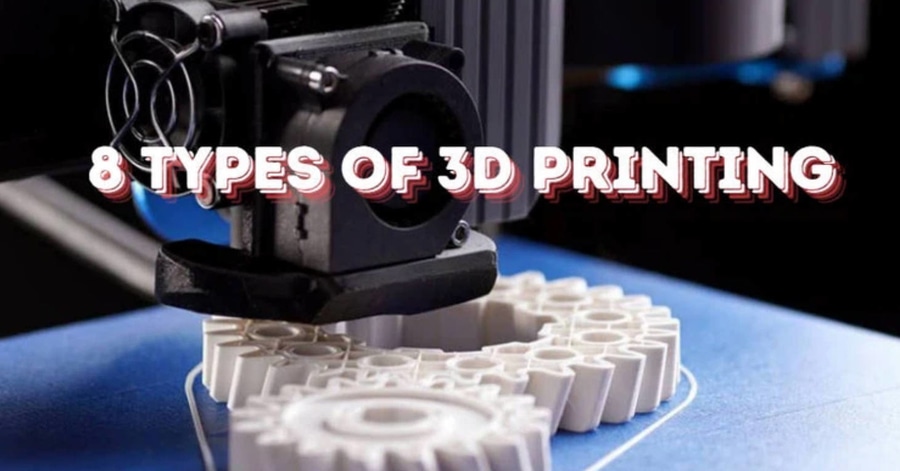
8 Types Of 3D Printing
8 Types Of 3D Printing
1. Introduction and Core Concept
3D printing, also known as additive manufacturing, is a production process where objects are created layer by layer from a digital 3D model. Unlike traditional subtractive methods, which remove material, additive manufacturing adds material only where needed, allowing the creation of complex geometries and efficient prototyping.
2. Overview of the Process Workflow
The 3D printing workflow begins with a CAD model converted into a printable file format like STL or 3MF. Slicing software then divides the model into thin layers and generates machine instructions for the printer. During printing, material is deposited, cured, or fused according to those instructions, then finished with post-processing steps such as support removal or curing.
3. Stereolithography (SLA)
SLA uses a UV laser to selectively cure a liquid photopolymer resin layer by layer. This technology offers excellent surface finish and high detail, making it ideal for visual prototypes, molds, dental models, and medical applications where precision is important.
4. Selective Laser Sintering (SLS)
SLS employs a laser to sinter powdered thermoplastic materials. Since the surrounding powder supports the printed part, SLS can produce complex geometries without separate support structures. It is commonly used for functional prototypes and low-volume end parts.
5. Fused Deposition Modeling (FDM)
FDM works by melting and extruding thermoplastic filament through a heated nozzle to build parts layer by layer. It is one of the most accessible and cost-effective 3D printing methods, popular for rapid prototyping and basic functional components.
6. Digital Light Processing (DLP)
DLP is similar to SLA but uses a digital light projector to cure entire resin layers at once, resulting in faster print times while maintaining high resolution. It’s especially used in dental, jewelry, and detailed prototype applications.
7. Multi Jet Fusion (MJF) and PolyJet
MJF uses inkjet arrays to apply fusing and detailing agents to powder layers, which are then fused by heat to produce strong, isotropic parts with good surface quality, suitable for batch production. PolyJet jets liquid photopolymers and instantly cures them with UV light, enabling multi-material and multi-color printing for realistic prototypes and complex assemblies.
8. DMLS and EBM (Metal 3D Printing)
Direct Metal Laser Sintering (DMLS) fully melts metal powder with a laser to create dense, strong metal parts, widely used in aerospace, medical implants, and tooling. Electron Beam Melting (EBM) uses an electron beam in a vacuum to melt metal powder, especially suited for high-strength alloys like titanium that require superior fatigue resistance.