#Industry News
Sinker EDM Vs Wire EDM: Decoding The Machining Choices
Sinker EDM Vs Wire EDM
1. What EDM Is and the Shared Principle
Both Sinker EDM and Wire EDM fall under the broader category of Electrical Discharge Machining (EDM), a non-contact machining process that uses electrical discharges (sparks) between an electrode and a workpiece to remove material. These discharges occur in a dielectric fluid and can machine extremely hard conductive metals with very high precision. EDM is especially useful where traditional cutting tools struggle due to hardness or complex geometry.
2. Sinker EDM: Basic Concept and How It Works
Sinker EDM (also called die sinking or ram EDM) uses a pre-shaped, three-dimensional electrode, typically made from graphite or copper, that is plunged into the workpiece submerged in dielectric fluid. Controlled electrical pulses erode the workpiece to match the shape of the electrode, allowing intricate 3D cavity and feature machining.
3. Wire EDM: Basic Concept and How It Works
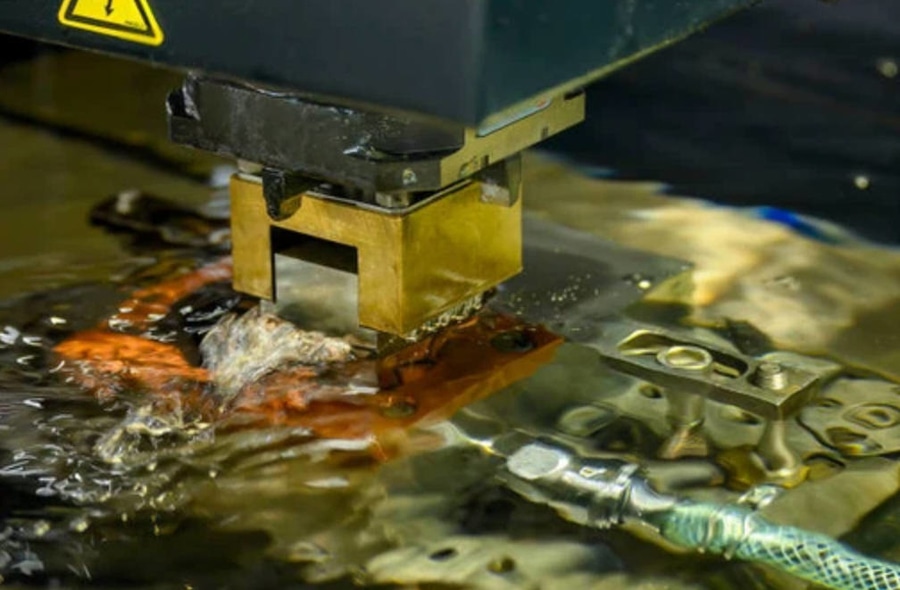
Wire EDM uses a thin, continuously fed wire (often brass or tungsten) as the electrode, which cuts through the workpiece like a very precise saw powered by sparks rather than physical contact. The workpiece does not need full submersion; the wire advances and erodes material, enabling very accurate 2D contour cutting and profiles with tight tolerances.
4. Electrode and Motion Differences
In Sinker EDM, the electrode is a solid, shaped tool that descends predominantly along the Z-axis to form cavities matching its geometry. In contrast, Wire EDM moves a fine wire primarily along the X and Y axes, cutting features through the thickness of the workpiece. The different electrode types and motion directions fundamentally differentiate the kinds of shapes each method can produce.
5. Advantages of Sinker EDM
Sinker EDM is especially strong at producing complex 3D shapes, deep cavities, blind features, and internal contours that would be difficult or impossible to machine conventionally. It also excels with hard materials, since the electrode material does not need to be harder than the workpiece, and it avoids issues like tool wear that plague contact cutting methods.
6. Limitations of Sinker EDM
However, Sinker EDM is generally slower and less efficient for large volumes of material removal. Managing waste, flushing dielectric from deep recesses, and maintaining discharge consistency in deep cavities can present challenges that affect cycle time and setup complexity.
7. Advantages of Wire EDM
Wire EDM offers exceptional precision, high material utilization, and lower processing cost compared with Sinker EDM. It is ideal for cutting thin or flat parts, intricate profiles, sharp corners, and tight tolerance features. Because the wire is continuously fed, the process has high efficiency and shorter production cycles, and minimal erosion means good material yield, a big advantage when machining expensive metals.
8. Limitations of Wire EDM and Application Guidance
Wire EDM cannot produce blind cavities, closed-bottom recesses, or deeply undermined features because the wire must pass completely through the part. It is limited to electrically conductive materials by the nature of EDM. Choosing between the two techniques depends on workpiece thickness, geometry complexity, precision needs, production volume, surface finish goals, and budget, with Wire EDM generally favored for precision 2D cutting and Sinker EDM for deep, complex 3D shaping.