#Industry News
Types Of Gears And Their Uses: Complete Engineering Guide (2026)
Types Of Gears And Their Uses
1. What Are Gears and Why Are They Important?
Gears are mechanical components designed with precise tooth profiles that mesh together to transmit motion and power between rotating shafts. They play a critical role in controlling speed, torque, and direction of movement in mechanical systems. Compared with other transmission methods such as belts or friction drives, gears provide higher efficiency, better reliability, and more accurate power transfer, making them essential in modern industrial equipment.
2. How Gears Work
Gears operate by transferring force through the engagement of their teeth. When one gear rotates, it drives the mating gear, creating a controlled motion relationship. The size and number of teeth determine how speed and torque are converted. Larger gears generally reduce speed while increasing torque, whereas smaller gears increase speed but reduce torque. This principle enables engineers to design systems that meet specific performance requirements in various applications.
3. Classification of Gear Types
Gear types are commonly classified based on the relative position of the shafts they connect. In systems where shafts are parallel, gear types such as spur gears and helical gears are typically used due to their simplicity and efficiency. When shafts intersect, bevel gears are often applied to change the direction of motion, usually at a right angle. In cases where shafts are neither parallel nor intersecting, specialized gears such as worm gears or hypoid gears are used to achieve compact layouts and high reduction ratios.
4. Common Gear Types and Their Uses
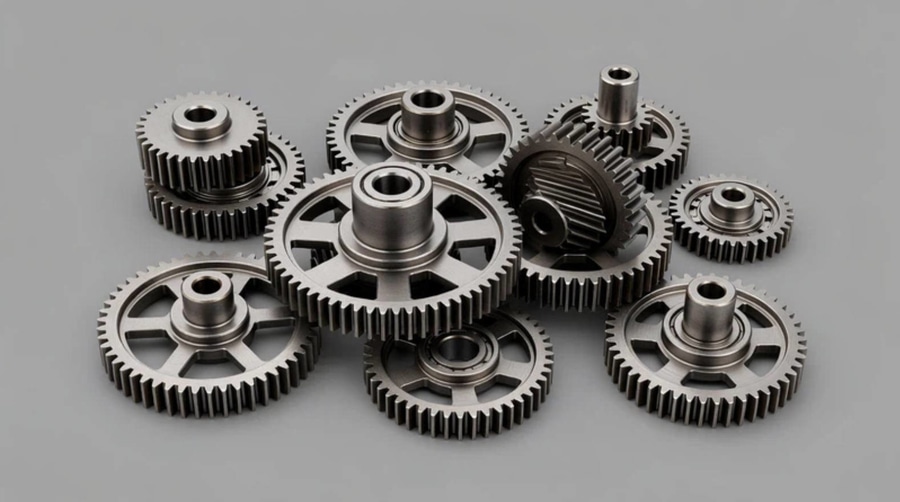
Spur gears are the most basic and widely used type, featuring straight teeth and high efficiency, making them suitable for simple transmission systems. Helical gears, with angled teeth, offer smoother and quieter operation and are commonly found in automotive and high-speed machinery. Bevel gears are designed to transmit motion between intersecting shafts and are frequently used in differential systems and power tools. Worm gears are known for their ability to provide large speed reductions within a compact space, making them ideal for lifting systems and conveyors. Rack and pinion systems convert rotational motion into linear movement and are widely applied in steering mechanisms and automation equipment.
5. Why Gear Selection Matters
The choice of gear type depends on multiple engineering considerations, including load capacity, operating speed, efficiency requirements, noise control, and installation space. Selecting the appropriate gear not only improves system performance but also reduces wear, extends service life, and lowers maintenance costs. In many industrial applications, even small differences in gear design can significantly impact overall system reliability.
6. Applications Across Industries
Gears are widely used across a variety of industries, including automotive systems, industrial automation, robotics, aerospace equipment, and manufacturing machinery. Their ability to deliver precise and consistent motion makes them indispensable components in both heavy-duty equipment and high-precision systems. As industrial technology continues to evolve, gear design and manufacturing are also advancing to meet higher demands for efficiency and durability.
7. Conclusion
Understanding the different types of gears and their applications helps engineers and buyers make informed decisions when designing or sourcing mechanical components. Each gear type offers distinct advantages depending on the working conditions and system requirements. At HLC, we provide precision manufacturing solutions for a wide range of metal components, supporting customers with reliable quality and customized production capabilities for industrial applications.