
#Industry News
Power Meets Precision: How to Perfectly Match Ceramic Bead Size with Blasting Pressure
How to Optimize Your Surface Treatment Process Through Precision Media Selection
In abrasive blasting, selecting the correct ceramic bead size for the right pressure isn’t just a technical detail—it’s a core performance factor. When properly matched, bead size and pressure work in harmony to deliver consistent surface results, minimize media loss, and prolong equipment life. If mismatched, the result can be wasted resources, uneven finishes, and increased costs.
This guide will walk you through how different ceramic bead sizes respond to various blasting pressures and how to make the right pairing for your specific application.
1. Why Ceramic Beads?
Ceramic beads offer several advantages compared to traditional blasting media:
High hardness and impact resistance
Spherical shape for consistent surface texture
Long recycling lifespan
Low dust generation
Chemically inert and non-contaminating
To fully leverage these benefits, it's crucial to choose the appropriate grain size in relation to the blasting pressure applied.
2. Understanding Grain Size vs. Pressure
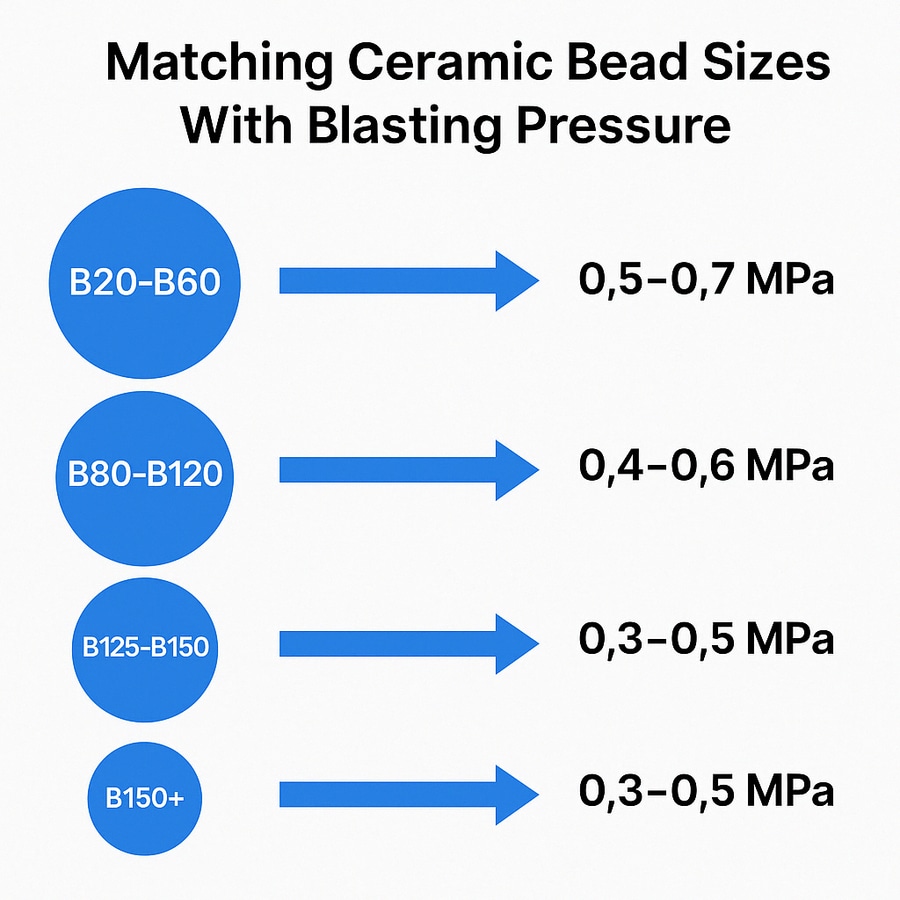
Ceramic bead grain sizes typically range from coarse (e.g., B20) to ultra-fine (e.g., B150+). Their performance characteristics vary significantly depending on the pressure used:
Coarse beads (B20–B60) perform best at higher air pressures (0.5–0.7 MPa). They are ideal for heavy-duty cleaning, oxide removal, or aggressive surface texturing on castings or forged parts.
Medium beads (B80–B120) are suitable for moderate pressures (0.4–0.6 MPa). They offer a balanced solution for general surface cleaning, paint removal, and surface preparation before coating.
Fine beads (B125–B150+) work well with lower pressures (0.3–0.5 MPa), making them ideal for delicate parts, thin-walled components, or polishing applications where minimal surface damage is crucial.
3. Why Proper Matching Matters
Incorrect combinations can result in:
Surface damage or over-peening
Inconsistent roughness or texture
Increased dust and media breakdown
Lower efficiency and higher operational costs
Poor coating adhesion due to improper profile
When matched correctly, bead size and pressure maximize cleaning power while preserving the integrity of the base material.
4. Practical Guidelines
Know your substrate
Harder materials can tolerate larger beads and higher pressures, while soft or precision components require finer media and lower PSI.
Define your end goal
Surface roughening, cleaning, coating preparation, and aesthetic finishing each call for different pressure and grain size pairings.
Test and adjust
Always conduct small trials and adjust the pressure in increments to find the optimal setting for your specific application
Watch for wear
If your media breaks down quickly or surface results vary, it may be a sign of excessive pressure for that particular bead size
5. Real-World Examples
B30 at 0.6 MPa: Suitable for descaling stainless steel components
B80 at 0.5 MPa: Ideal for preparing aluminum surfaces for powder coating
B120 at 0.4 MPa: Used for creating uniform matte finishes on medical housings
B150 at 0.3 MPa: Preferred for gentle cleaning of aerospace alloys or precision parts
Each application benefits from a deliberate match of grain size and pressure.
Conclusion: Precision is Profit
Matching ceramic bead sizes with the correct blasting pressure ensures:
Superior and consistent surface quality
Lower media consumption
Reduced equipment maintenance
Improved operator safety and cleaner workspaces
Greater process control and customer satisfaction
Blasting is not simply about force—it's about finesse. By understanding and applying the correct media-pressure combination, you not only enhance your surface treatment performance but also gain a competitive edge in cost, quality, and efficiency.
#CeramicBeads #BlastingPressure #SurfacePreparation #AbrasiveBlasting #IndustrialCleaning #PrecisionBlasting #MediaSelection #BlastingTips #ManufacturingQuality #ProcessOptimization