
#Industry News
Data centre air monitoring: how technical reliability becomes regulatory standard
Virginia's DEQ demonstrates that near-reference sensors transform environmental governance for hard-to-measure industries
Data centres generate emissions that defy conventional measurement. They lack permanent stacks, do not pollute continuously, and their impacts are diffuse, multi-source and cumulative. For years, that characteristic kept them outside rigorous regulatory scrutiny. Now that is changing. In February 2026, Virginia's Department of Environmental Quality (DEQ) launched the Data Center Air Monitoring Project, a pioneering programme to characterise with measurable data the real impact of more than 100 data centres operated in Loudoun County, the densest digital infrastructure corridor in the United States.
The challenge: intermittent emissions, cumulative impact
Loudoun County hosts facilities operated by Amazon, Google and Meta. Each maintains tens of diesel backup generators that start during monthly load tests and power interruptions. During those events, they emit NO2, CO and PM2.5 in concentrated pulses. The problem is not individual; it is collective. When tens of generators start within a radius of just a few kilometres, the cumulative impact on surrounding air quality is measurable and relevant to public health.
Recent studies estimate that consolidated data centre emissions in Virginia could produce approximately 1,300 premature deaths annually and 600,000 cases of asthma symptoms, with a health cost close to $20 billion. Adjacent communities, aware of this risk, demanded access to objective data. Citizen pressure became the catalyst that transformed regulatory intent into action.
The solution: sensor networks with near-reference performance
The DEQ designed a network of 22 potential locations across Loudoun County, covering downwind positions (pollution receptors), upwind (baseline) and interior areas within the study zone. The critical technical decision was to place sensors alongside the official reference monitoring station in Ashburn to enable real-time cross-validation of data.
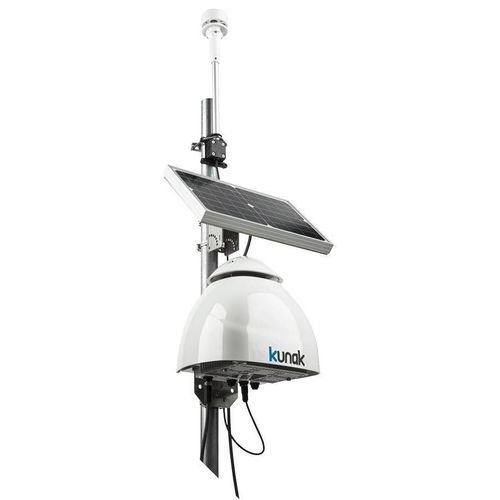
For this, the DEQ selected Kunak AIR Pro sensors. The EPA, recognising the need for reliable equipment in critical environmental applications, has procured and made available to state agencies Kunak sensors with MCERTS certifications (UK Environment Agency) and CEN/TS 17660 (European specification for air monitoring), which accredit near-reference performance under field conditions.
The DEQ chose these sensors for their technical capabilities: multiparametric architecture allowing simultaneous measurement of NO2, CO and PM2.5 without separate units, eSIM connectivity for real-time transmission, and integration with BMS systems for automatic alerts. Seven units were deployed in February 2026; following a seven-day calibration period, data collection began in March. The sensors correlate emission peaks with specific generator operation events, enabling immediate action without waiting for annual campaign closure.
Verifiable results and public governance
Initial data show concentrations within NAAQS limits: NO2 did not exceed 35 ppb (limit: 100 ppb), CO remained below 2.6 ppm (limit: 35 ppm) and PM2.5 did not surpass 35.0 µg/m3. Yet the value lies not in the numbers themselves, but in traceability. The DEQ publishes data in near-real time through a public web portal. Citizens verify the air they breathe without intermediaries, without waiting for annual reports, without need for technical knowledge.
Precedent for complex industries
The model is replicable. Emerging data centre corridors in Spain (Henares), Indonesia (Greater Jakarta) and Malaysia are experiencing similar regulatory pressures. International financiers demand verifiable evidence of environmental performance as a condition of investment. For operators with ESG commitments, traceable data from continuous monitoring networks are not compliance costs but defensible assets against third-party audits.
When available technology enables measurement of what was previously invisible, governance shifts. Regulators demand data. Communities claim it. Industries that anticipate this transition, choosing robust technical solutions as the EPA and DEQ do, protect their operating licence and transform risk into competitive advantage.