#Product Trends
Custom Exhaust Blankets for Complex Exhaust Components
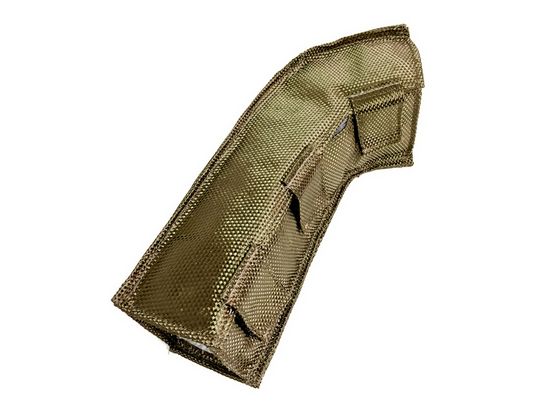
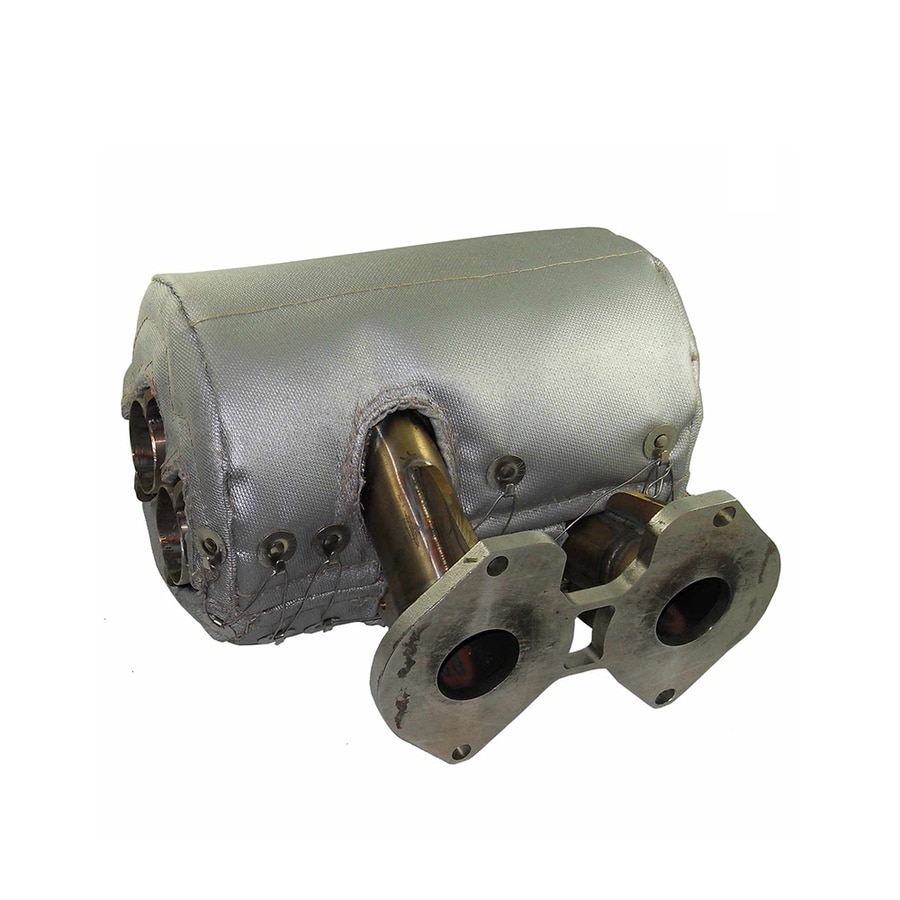
Custom-shaped exhaust insulation blankets provide close-fit thermal protection for manifolds, elbows, turbochargers, mufflers, flanges and irregular piping.
Standard insulation products work well on simple straight pipes, but many exhaust systems contain components with complex shapes, restricted clearances and multiple connection points. In these situations, custom exhaust blankets provide a more effective solution because they are designed around the actual geometry of the exhaust component.
A custom exhaust blanket is a removable high-temperature insulation jacket manufactured according to drawings, dimensions, 3D models, templates or physical samples. The goal is to achieve close coverage around irregular exhaust components while maintaining access to bolts, sensors, flanges, brackets and service points.
Custom exhaust blankets are commonly used on:
Exhaust manifolds
Turbocharger housings
Exhaust elbows
Mufflers and silencers
Flexible exhaust joints
Flanges
Expansion joints
Catalytic exhaust components
Generator exhaust assemblies
Marine engine exhaust systems
Industrial process exhaust equipment
Complex exhaust components can create localized hot spots that are difficult to control with conventional wrap or straight pipe insulation. A custom blanket can be segmented and shaped to follow curves, transitions and irregular surfaces more closely, reducing exposed areas where radiant heat can escape.
The blanket construction is normally based on several functional layers.
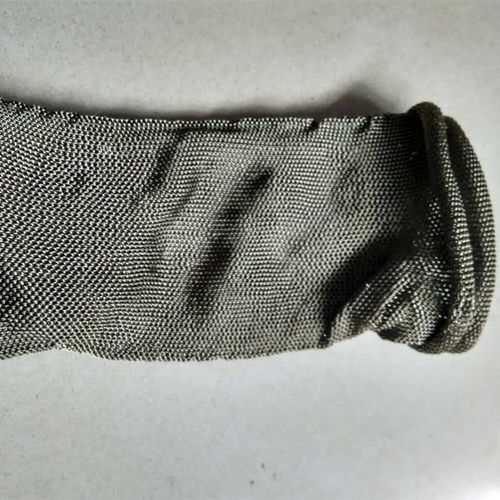
The inner hot-face layer is selected for direct exposure to elevated exhaust temperatures. Depending on the application, materials may include fiberglass fabric, high silica fabric, stainless steel mesh or other heat-resistant textiles.
The insulation core provides the primary thermal resistance. Fiberglass, silica-based insulation and ceramic fiber materials can be selected according to operating temperature, available space and required surface temperature reduction.
The external layer protects the insulation against abrasion, vibration, oil, moisture and repeated handling. Silicone-coated fiberglass and other durable technical fabrics are often used where additional environmental protection is required.
Fastening design is especially important on complex components.
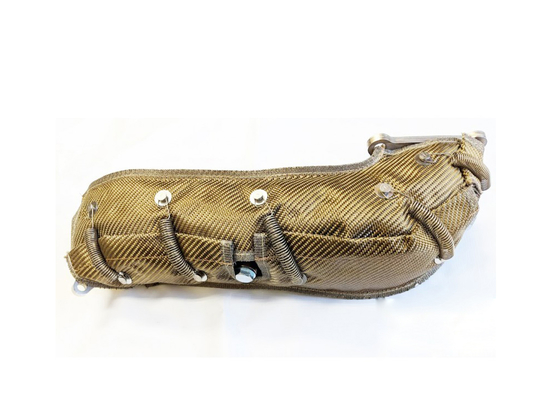
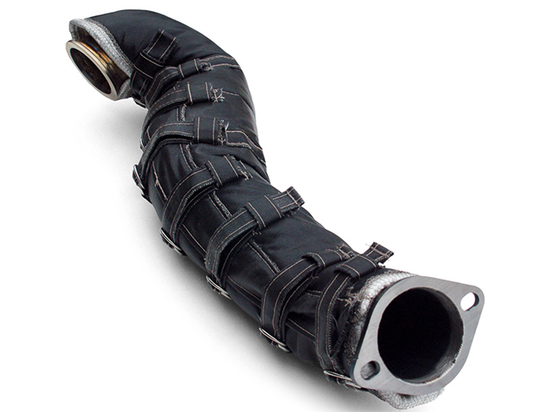
Custom exhaust blankets may use hooks, springs, lacing wire, straps, buckles or other removable fastening systems. The fastening method should provide secure installation while allowing maintenance personnel to remove and reinstall the blanket without damaging the insulation.
For exhaust manifolds, individual sections may be designed around branches, collectors and flanges.
For turbochargers, shaped blankets can follow the turbine housing while leaving actuator mechanisms, oil lines and service areas accessible.
For exhaust elbows and flex joints, segmented construction can accommodate changes in direction and localized movement.
For mufflers and silencers, larger removable jackets can be manufactured around cylindrical, oval or custom-shaped bodies.
This component-specific design approach provides advantages over generic insulation methods.
A poorly fitted blanket can leave gaps, compress insulation unevenly or interfere with nearby components. By contrast, a custom exhaust insulation blanket can be designed with controlled thickness, defined overlap areas and dedicated openings for sensors, mounting points and connections.
Custom exhaust blankets are particularly valuable in compact installations.
Generator enclosures, marine engine rooms, heavy-duty equipment and industrial machinery often have limited clearance between exhaust components and heat-sensitive systems. Wiring, hydraulic hoses, fuel lines, electronic controls and structural surfaces may be located close to the exhaust.
Containing heat directly around the source can help reduce the thermal load on these nearby components.
Engineers specifying custom exhaust blankets should consider:
Component geometry
Maximum operating temperature
Continuous temperature
Required surface temperature reduction
Available installation clearance
Insulation thickness
Vibration
Oil and moisture exposure
Fastening locations
Sensor and bracket positions
Maintenance access
Blanket removal direction
Required service life
The design should also consider how the component will be serviced.
A technically effective insulation blanket may still create maintenance problems if it cannot be removed without dismantling surrounding equipment. For this reason, larger components can be divided into several removable blanket sections so that maintenance personnel only remove the area requiring access.
Custom exhaust blankets can also be used as part of a broader thermal management system. For example, a manifold or turbocharger blanket can contain heat at the source while a secondary metal heat shield protects a nearby electrical component from remaining radiant heat.
BSTFLEX manufactures custom exhaust blankets for automotive, diesel engine, generator, marine and industrial exhaust systems. Blankets can be developed from technical drawings, customer dimensions, templates or component samples.
Different hot-face materials, insulation cores, outer fabrics, thicknesses and fastening systems can be selected according to the operating environment and thermal requirements.
For irregular exhaust components where standard pipe insulation cannot provide adequate coverage, a properly engineered custom exhaust blanket offers a practical method of reducing radiant heat, controlling external surface temperature and maintaining convenient access for inspection and maintenance.