#Product Trends
Exhaust Manifold Heat Protection for High Temperature Engine Systems
Exhaust Manifold Heat Protection
Exhaust Manifold Heat Protection for High Temperature Engine Systems
Managing Heat Around High Temperature Exhaust Manifolds
Exhaust manifold heat protection is used to control the intense heat generated around an engine exhaust manifold and reduce its impact on surrounding components.
The exhaust manifold is one of the most thermally demanding areas of an engine. Hot exhaust gases leave the cylinders through the manifold before moving toward the turbocharger, downpipe, catalytic system, or exhaust piping. The manifold surface can therefore become a significant source of radiant and convective heat inside the engine compartment.
When the manifold is located close to wiring, hoses, sensors, intake components, plastic parts, or other heat-sensitive equipment, thermal protection becomes an important part of engine design.
Depending on the application, protection may involve an exhaust manifold heat shield, insulation blanket, thermal barrier, or a combination of several layers.
Why Exhaust Manifolds Require Heat Protection
The geometry of an exhaust manifold makes thermal management particularly challenging.
Unlike a straight exhaust pipe, a manifold typically contains multiple runners merging into a collector. This creates a relatively large hot surface within a compact area.
Heat can reach nearby components through several mechanisms:
Radiant heat from the manifold surface
Convective heat transfer to surrounding air
Conductive transfer through mounting structures
Heat accumulation inside confined engine compartments
The objective of exhaust manifold heat protection is to control these heat paths without interfering with engine operation.
Effective protection can help reduce thermal exposure around:
Electrical wiring
Rubber hoses
Fuel-system components
Plastic components
Sensors
Intake systems
Engine covers
Nearby structural parts
What Is Exhaust Manifold Heat Protection?
Exhaust manifold heat protection refers to materials or engineered assemblies used to control heat around an exhaust manifold.
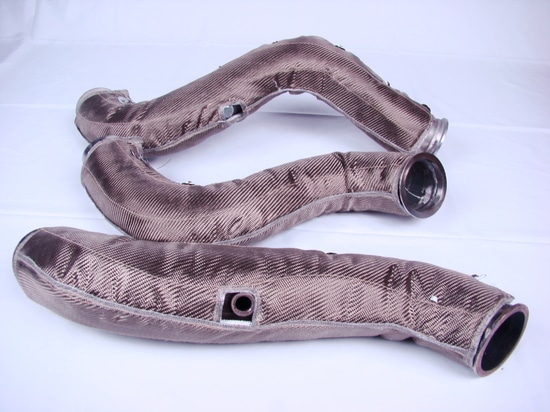
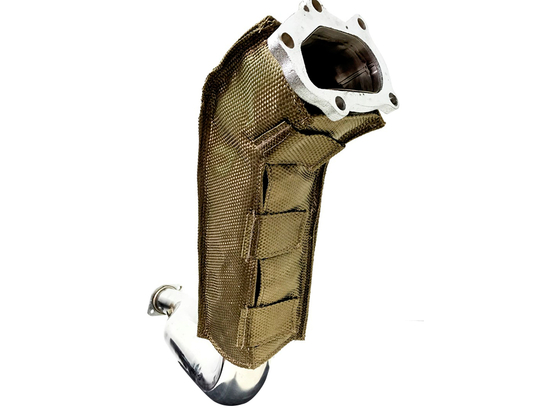
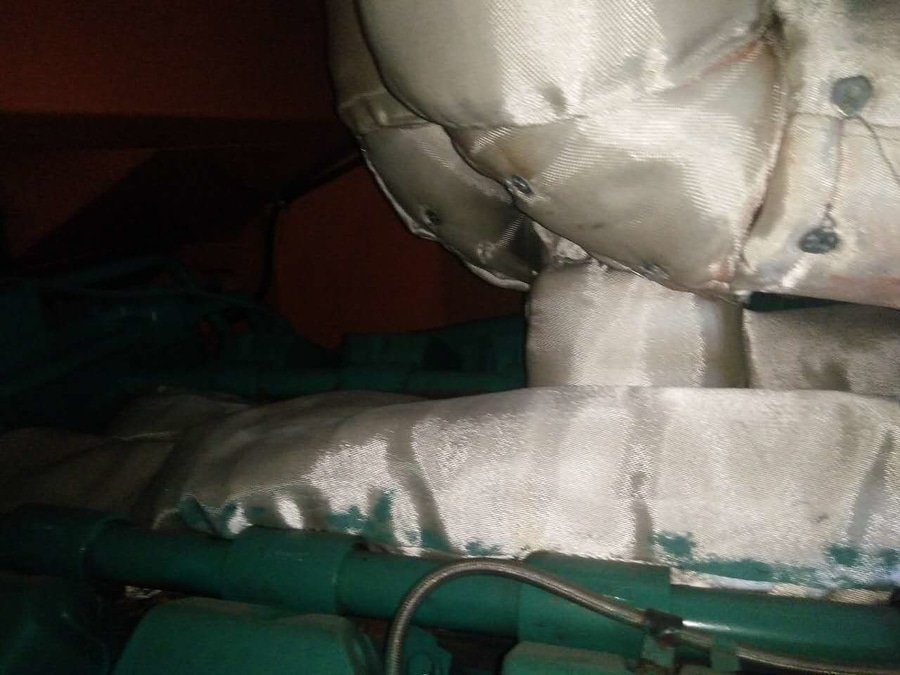
The solution may be a rigid shield positioned between the manifold and a sensitive component, a flexible insulation blanket installed directly around the manifold, or a multilayer system combining insulation with a reflective outer surface.
A typical removable manifold insulation blanket may include:
Layer Purpose
Inner high-temperature fabric Protects the insulation from the hot manifold
Thermal insulation Restricts heat transfer
Reflective barrier Helps reduce radiant heat
Outer protective fabric Provides mechanical protection
Fasteners Secure the blanket during engine operation
The final configuration depends on the temperature, geometry, clearance, vibration, and service requirements.
Exhaust Manifold Heat Shield vs Insulation Blanket
An exhaust manifold heat shield and an exhaust manifold insulation blanket can provide thermal protection in different ways.
A conventional heat shield is often positioned between the hot manifold and the component requiring protection.
Its primary function is to intercept and redirect radiant heat.
An insulation blanket is installed closer to or around the hot component and adds thermal resistance.
Characteristic Exhaust Manifold Heat Shield Insulation Blanket
Radiant heat control Strong Strong with reflective layer
Thermal insulation Limited to moderate High potential
Direct manifold coverage Usually limited Yes
Complex geometry Moderate Highly adaptable
Removability Possible Common
Flexible construction Limited Yes
Custom fabrication Possible Highly suitable
In some applications, combining both approaches provides a more complete thermal-management solution.
How Does Exhaust Manifold Heat Protection Work?
The protection system works by controlling how heat moves away from the manifold.
A thermal insulation layer increases resistance to heat transfer from the hot surface toward the exterior.
A reflective layer can reduce radiant energy reaching nearby components.
A physical air gap or external heat shield can further separate the hot manifold from sensitive components.
The most effective construction therefore depends on the actual thermal problem.
For example, if the primary concern is direct radiant exposure to a nearby wiring harness, a reflective shield may be highly useful.
If the objective is to reduce the external surface temperature of the manifold, a multilayer insulation blanket may provide greater thermal resistance.
Materials for Exhaust Manifold Heat Protection
Material selection should be based on both temperature and mechanical conditions.
Common materials include fiberglass fabric, silica fabric, ceramic fiber insulation, aluminized fabric, aluminum foil, and stainless steel mesh.
Fiberglass
Fiberglass fabric is suitable for many high-temperature thermal protection applications.
It provides flexibility and can be fabricated into shaped covers for irregular manifold geometry.
Silica Fabric
Silica fabric can be selected for applications involving higher thermal loads.
It is suitable for demanding exhaust manifold and turbocharger environments where high-temperature textile performance is required.
Ceramic Fiber
Ceramic fiber is typically used as a high-temperature insulation layer.
It can provide substantial thermal resistance while remaining suitable for flexible multilayer constructions.
Aluminum Foil
Aluminum foil can serve as a reflective barrier.
It is particularly useful when radiant heat from the manifold needs to be redirected away from nearby components.
Aluminized Fabric
Aluminized fabric provides a flexible reflective surface while offering greater mechanical flexibility than rigid metal shielding.
Stainless Steel Mesh
Stainless steel mesh can reinforce a blanket where vibration, handling, or mechanical durability is important.
Exhaust Manifold Insulation Blanket Construction
A manifold insulation blanket needs to follow the actual geometry of the component.
A generic cylindrical sleeve is generally unsuitable because the manifold may contain multiple branches, mounting points, bolt locations, and changing diameters.
A custom blanket can instead be divided into shaped sections.
For example:
Individual runner sections
Collector section
Flange section
Turbo connection area
Inspection opening
Sensor clearance
Mounting clearance
This allows the protection system to cover the required hot surfaces without interfering with surrounding components.
Removable Exhaust Manifold Heat Protection
Removability is particularly valuable for engines requiring regular inspection or servicing.
Exhaust manifolds may need to be removed for:
Engine maintenance
Turbocharger servicing
Sensor replacement
Exhaust inspection
Bolt inspection
Component replacement
Performance development
A removable insulation blanket can be opened and removed without destroying the insulation material.
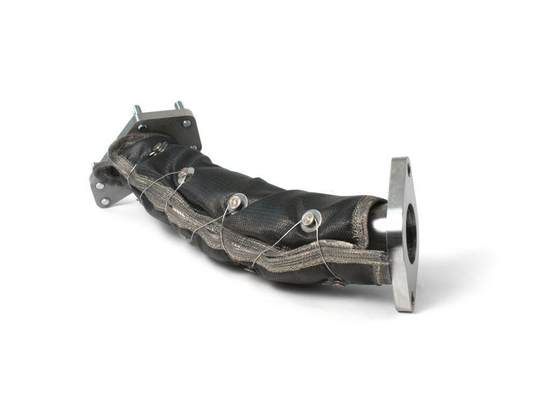
Fastening systems can include:
Stainless steel wire
Straps
Buckles
Hooks
Lacing systems
High-temperature mechanical fasteners
The fastening method should be selected according to vibration, temperature, and accessibility.
Exhaust Manifold Heat Protection for Turbocharged Engines
Turbocharged engines present particularly demanding thermal conditions.
The exhaust manifold is positioned upstream of the turbocharger, and the surrounding components can be exposed to substantial heat.
A thermal protection system may therefore need to cover both the manifold and the transition toward the turbocharger.
The design should consider the relationship between:
Engine → Exhaust Manifold → Turbocharger → Downpipe
Protecting only one component may leave significant heat paths around the remaining exhaust assembly.
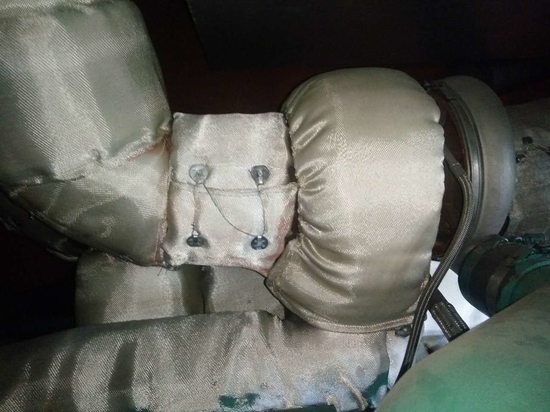
In some systems, separate blankets can be designed for the manifold, turbocharger housing, and connecting exhaust pipe.
Automotive Exhaust Manifold Heat Protection
Automotive engine compartments often provide limited space for thermal protection.
The manifold may be positioned close to the firewall, wiring, intake components, fuel-related components, or other systems.
This makes clearance an important design parameter.
A blanket that provides excellent insulation but contacts adjacent components may create a different problem.
For automotive applications, the completed outside dimensions of the insulation system should therefore be considered during design.
Industrial Engine Applications
Industrial engines may operate continuously for long periods and under high thermal loads.
Exhaust manifolds can become persistent heat sources inside equipment enclosures.
Heat protection can help reduce thermal exposure to adjacent equipment and contribute to overall engine-compartment thermal management.
For industrial machinery, durability and maintenance access may be more important than minimum weight.
A heavier multilayer construction may therefore be appropriate when it provides improved thermal resistance and mechanical durability.
Diesel Engine Exhaust Manifold Protection
Diesel engines commonly use robust exhaust systems designed for extended operating cycles.
The exhaust manifold can be exposed to high temperatures during sustained operation.
A custom insulation blanket can help reduce heat transfer from the manifold to surrounding equipment.
For diesel applications, the design should account for:
Continuous operating temperature
Engine vibration
Thermal expansion
Available clearance
Oil and dirt exposure
Maintenance frequency
Exhaust manifold geometry
The outer cover should be selected according to the actual environment surrounding the engine.
How to Select Exhaust Manifold Heat Protection
There is no universal heat-protection configuration for every manifold.
The selection process should begin with the actual application.
1. Identify the Heat Source
Determine whether the primary concern is the manifold surface, collector, turbocharger connection, or the complete exhaust assembly.
2. Determine Temperature
Measure or estimate the actual surface temperature during normal and maximum operation.
Material selection should provide an appropriate safety margin.
3. Identify Sensitive Components
Determine which components are being affected by the exhaust heat.
This establishes the actual thermal-management objective.
4. Measure Clearance
Record the distance between the manifold and nearby components.
The insulation thickness and outer diameter must fit within the available space.
5. Consider Vibration
Engine vibration can cause movement between the blanket, manifold, and surrounding structures.
The fastening system should be designed accordingly.
6. Consider Maintenance
If the manifold requires regular access, specify removable protection.
Common Exhaust Manifold Heat Protection Mistakes
Using Only a Reflective Shield
A reflective shield can reduce radiant heat exposure but may not sufficiently reduce the manifold's external temperature.
Where surface temperature is the primary concern, additional insulation may be required.
Selecting Insulation Without Considering Clearance
A thick blanket can create interference in a compact engine compartment.
Thermal performance and installation space must be evaluated together.
Ignoring Manifold Geometry
A manifold is rarely symmetrical.
A poorly fitted blanket can leave exposed areas or interfere with bolts, sensors, and mounting points.
Using Inappropriate Outer Materials
The outer layer may encounter oil, moisture, abrasion, vibration, and mechanical contact.
The external environment should therefore be considered during material selection.
Making the System Permanent
If maintenance is expected, a removable design can significantly simplify future servicing.
Custom Exhaust Manifold Heat Protection
Custom fabrication is particularly useful for exhaust manifolds because their geometry varies considerably between engines.
A custom protection system can be developed from:
Engineering drawings
CAD data
Component dimensions
Physical samples
Photographs
Installation measurements
The blanket can then be patterned around the actual manifold.
Separate sections can be created where necessary to simplify installation and removal.
The design can also incorporate openings for sensors, bolts, brackets, and other service points.
Exhaust Manifold Heat Protection and Engine Thermal Management
Manifold insulation should be considered as part of the broader engine thermal-management system.
The exhaust manifold interacts thermally with the turbocharger, exhaust pipe, engine enclosure, intake system, wiring, and surrounding components.
Improving protection around one area may therefore change the thermal conditions elsewhere.
A complete thermal-management strategy should consider:
Exhaust manifold
Turbocharger
Exhaust pipe
Downpipe
Engine enclosure
Nearby wiring
Intake components
Ventilation
Heat-sensitive equipment
The best result comes from controlling the dominant heat paths rather than simply adding insulation everywhere.