#Product Trends
Marine Exhaust Insulation for Engine Room Heat Management
Marine Exhaust Insulation
Marine exhaust insulation is used to control heat generated by marine engine exhaust systems and reduce the amount of thermal energy transferred into the surrounding engine room. It can be applied to exhaust pipes, manifolds, elbows, turbocharger outlets, mufflers and other high-temperature components.
Heat management becomes particularly important on marine equipment because exhaust systems are often installed in compact engine compartments with limited ventilation and restricted clearance. Hot exhaust surfaces can expose nearby wiring, hoses, sensors, fuel-system components and structural parts to elevated temperatures.
A properly designed marine exhaust insulation system creates a thermal barrier around these components while allowing the exhaust system to operate at its intended temperature.
For serviceable marine equipment, removable insulation blankets are often a practical solution. They can be manufactured to match complex exhaust geometries and removed when inspection or maintenance is required.
BSTFLEX supplies custom marine exhaust insulation solutions for diesel engines, marine generators, commercial vessels, workboats and other high-temperature marine power systems.
Why Marine Engine Exhaust Insulation Matters
Marine exhaust systems can operate at temperatures far above the temperature of the surrounding engine compartment. Without thermal protection, heat is transferred from the exhaust surface through radiation and convection.
In a confined engine room, this heat can accumulate around nearby components.
The purpose of exhaust insulation is therefore broader than simply protecting the exhaust pipe. It is part of the overall thermal-management strategy of the engine compartment.
A suitable insulation system can help:
Reduce exhaust surface temperature
Limit radiant heat transfer
Protect nearby components
Reduce heat accumulation in confined spaces
Improve working conditions around hot machinery
Protect electrical wiring and hoses from excessive heat
Reduce thermal exposure of sensitive equipment
Improve the overall organization of the engine-room thermal environment
The achievable temperature reduction depends on the exhaust temperature, insulation construction, thickness, surface area and surrounding conditions.
Marine Exhaust Components Requiring Insulation
Different sections of a marine exhaust system present different thermal and mechanical challenges.
Exhaust Pipe Insulation
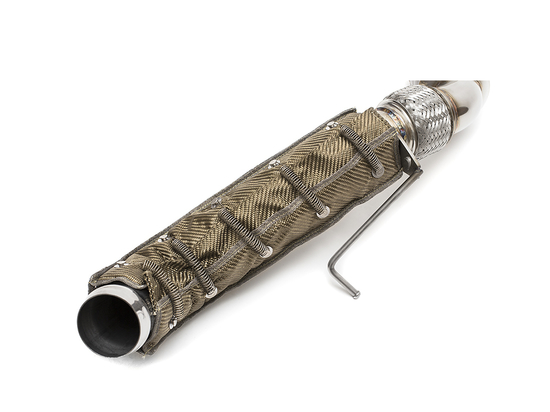
Straight exhaust pipes are relatively simple to cover, but the insulation still needs to accommodate pipe diameter, available clearance and maintenance access.
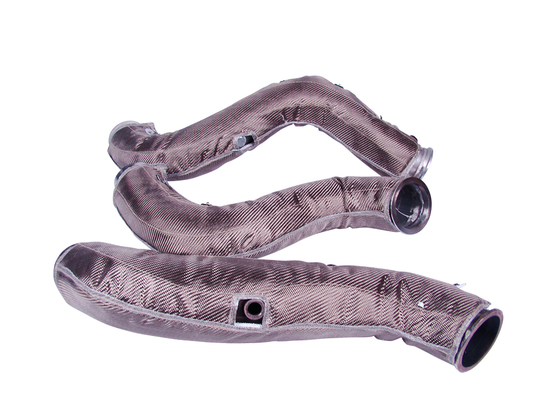
A removable pipe insulation blanket can be fabricated as a fitted cylindrical cover rather than using a permanently installed material.
Exhaust Manifold Insulation
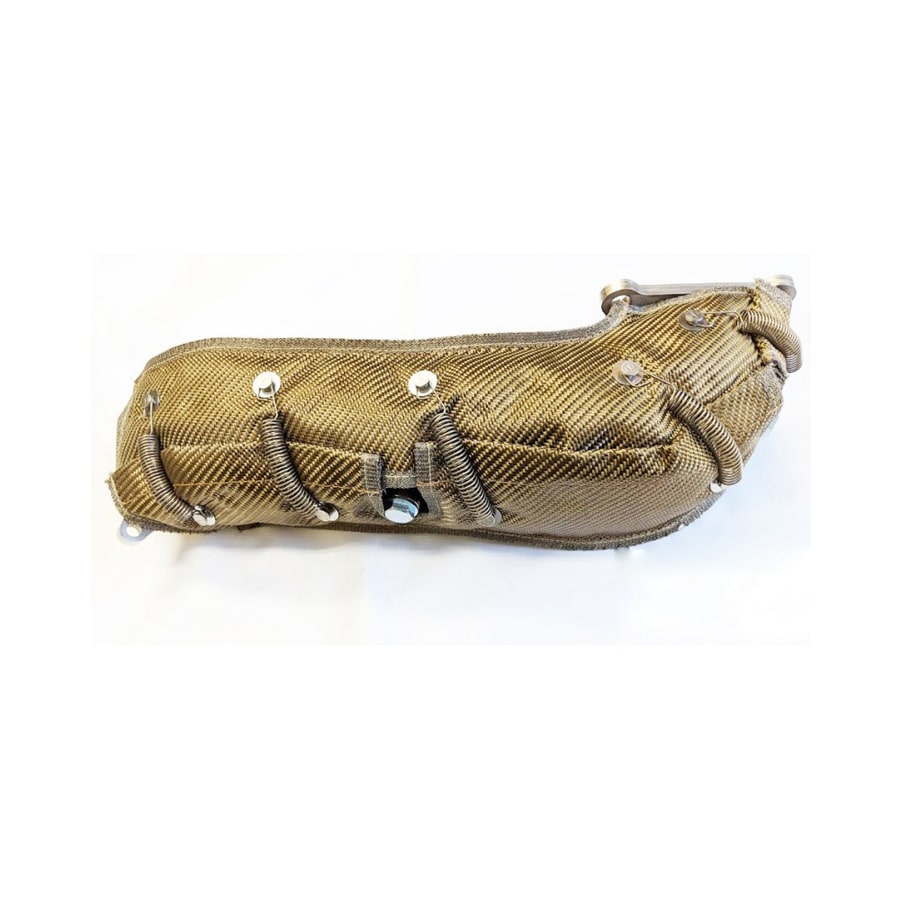
The manifold is often one of the more demanding areas of a marine engine exhaust system. It may contain multiple branches and connection points within a compact area.
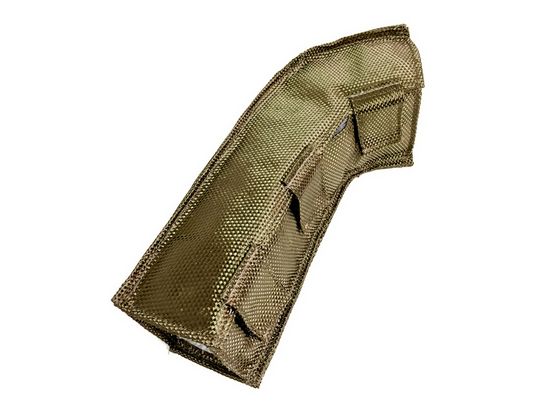
A custom blanket can follow the manifold geometry while providing openings for mounting hardware and service components.
Exhaust Elbow Insulation
Elbows require specially shaped insulation because their diameter and direction change along the component.
Instead of forcing a straight sleeve around the bend, a multi-piece blanket can be patterned around the actual geometry.
Turbocharger Insulation
The turbocharger exhaust side can generate significant heat and may be located close to other engine components.
Custom high-temperature insulation can be designed around the available space while maintaining access to connection points and service areas.
Muffler Insulation
Marine exhaust mufflers can have relatively large surface areas and may be positioned in confined spaces.
A sectional insulation blanket can cover the body while allowing access to flanges, brackets and other connection points.
Materials for Marine Exhaust Insulation
There is no single material suitable for every marine exhaust system.
Material selection should be based on temperature, flexibility, mechanical conditions, environmental exposure and required service life.
Fiberglass
Fiberglass fabrics and insulation are commonly used for marine thermal-protection applications because they combine high-temperature resistance with flexibility.
They are suitable for many exhaust pipes and components where the operating temperature is within the material's design range.
Silica
Silica fabric and silica insulation can be used for applications requiring greater resistance to high-temperature exposure.
They are particularly useful for demanding exhaust areas where standard fiberglass construction may not provide sufficient temperature capability.
Ceramic Fiber
Ceramic fiber insulation provides high-temperature performance for demanding exhaust applications.
It can be incorporated as the insulation core of a custom blanket when the component temperature requires a higher-temperature insulation solution.
Silicone-Coated Fiberglass
Silicone-coated fiberglass can be used as an outer protective fabric where flexibility, handling resistance and fabric protection are important.
The coating also provides a more durable exterior for applications involving frequent handling or installation.
Aluminized Fabric
Aluminized materials can provide reflective thermal protection and may be useful where radiant heat management is an important consideration.
The selection of an aluminized outer surface should be based on the specific thermal environment and required construction.
How Marine Exhaust Insulation Is Constructed
A high-temperature marine insulation blanket normally uses multiple layers, with each layer performing a specific function.
The outer fabric provides mechanical protection.
The insulation core provides thermal resistance.
An inner fabric or facing can protect the insulation from direct exposure to the hot component.
The fastening system keeps the blanket securely positioned around the exhaust component.
This layered construction allows the insulation system to be optimized instead of relying on a single material to perform every function.
For example, a marine exhaust blanket may combine a high-temperature textile outer cover with a fiberglass, silica or ceramic insulation core and a stainless steel fastening system.
The exact combination depends on the operating conditions.
Design Considerations for Marine Engine Rooms
Marine engine rooms create several design challenges that should be considered before manufacturing the insulation.
Limited Clearance
Space around marine exhaust systems is frequently restricted.
The insulation thickness must therefore provide an appropriate balance between thermal performance and physical clearance.
If the blanket is too thick, it may interfere with nearby equipment, brackets or access points.
Complex Geometry
Marine exhaust assemblies often contain multiple bends, branches and fittings.
Custom patterns are useful for these applications because the insulation can follow the actual component geometry.
Vibration
Engine vibration can place continuous mechanical stress on insulation.
The blanket should be secured with a fastening system appropriate for the component and operating conditions.
Repeated Thermal Cycling
Marine engines repeatedly transition between different operating temperatures.
The insulation construction should therefore accommodate expansion, contraction and repeated heating and cooling cycles.
Maintenance Access
An exhaust system may need to be inspected or serviced several times during its operating life.
A removable blanket allows technicians to access the component without permanently damaging the insulation.
Moisture and Corrosion Environment
Marine equipment is frequently exposed to moisture and humid conditions.
The outer textile, stitching and fastening hardware should be selected according to the actual installation environment.
Removable Marine Exhaust Insulation
Removable construction is particularly valuable when the insulated component requires periodic maintenance.
Instead of permanently bonding or wrapping insulation around the exhaust component, a removable blanket can be fitted using mechanical fasteners.
The blanket can then be opened or removed when the component needs to be inspected.
This design can be applied to:
Exhaust manifolds
Exhaust pipes
Elbows
Flanges
Turbocharger outlets
Mufflers
Expansion sections
Exhaust connection points
For larger systems, several individual blanket sections can be installed rather than producing one large cover.
This makes replacement and maintenance more manageable.
Marine Exhaust Insulation for New and Existing Equipment
Custom insulation is not limited to newly designed marine engines.
Existing exhaust systems can also be insulated after installation.
For retrofit projects, the manufacturer can work from measurements, photographs, drawings or physical templates to produce insulation that matches the installed component.
This is useful when:
Engine-room temperatures are higher than expected
Nearby hoses or wiring require additional heat protection
Existing exhaust insulation has deteriorated
Equipment has been modified
A replacement engine has changed the exhaust configuration
Additional thermal protection is required after installation
Retrofit insulation can be designed around the existing exhaust assembly without requiring the entire system to be redesigned.
How to Select Marine Exhaust Insulation
Before specifying the insulation, several parameters should be established.
Design Factor Why It Matters
Exhaust temperature Determines suitable insulation materials
Peak temperature Establishes required high-temperature capability
Pipe diameter Determines blanket dimensions
Component geometry Defines the required pattern
Available clearance Limits insulation thickness
Vibration Influences fastening construction
Thermal cycling Affects material durability
Moisture exposure Influences outer fabric and hardware
Maintenance requirements Determines removable or sectional design
Required surface temperature Helps determine insulation thickness
Accurate information at the design stage helps avoid problems during installation.
Custom Marine Exhaust Insulation Manufacturer
BSTFLEX manufactures custom marine exhaust insulation for high-temperature engine and exhaust applications.
Solutions can be developed for individual exhaust pipes or complete exhaust assemblies, including manifolds, elbows, turbocharger connections, mufflers and flanges.
Depending on the application, the insulation construction can incorporate fiberglass, silica, ceramic fiber, aluminized fabric, silicone-coated fiberglass and other high-temperature materials.
Custom dimensions, openings, fastening systems and sectional designs can also be provided.
For a new marine exhaust insulation project or a retrofit application, useful technical information includes component dimensions, operating temperature, photographs or drawings, required insulation thickness and available installation clearance.
The resulting insulation blanket can then be designed around the actual marine exhaust configuration rather than relying on a generic one-size-fits-all product.