#Product Trends
Exhaust Pipe Insulation Heat Shield for High Temperature Protection
Exhaust Pipe Insulation Heat Shield
Exhaust Pipe Insulation Heat Shield for High Temperature Protection
Combining Thermal Insulation With Radiant Heat Protection
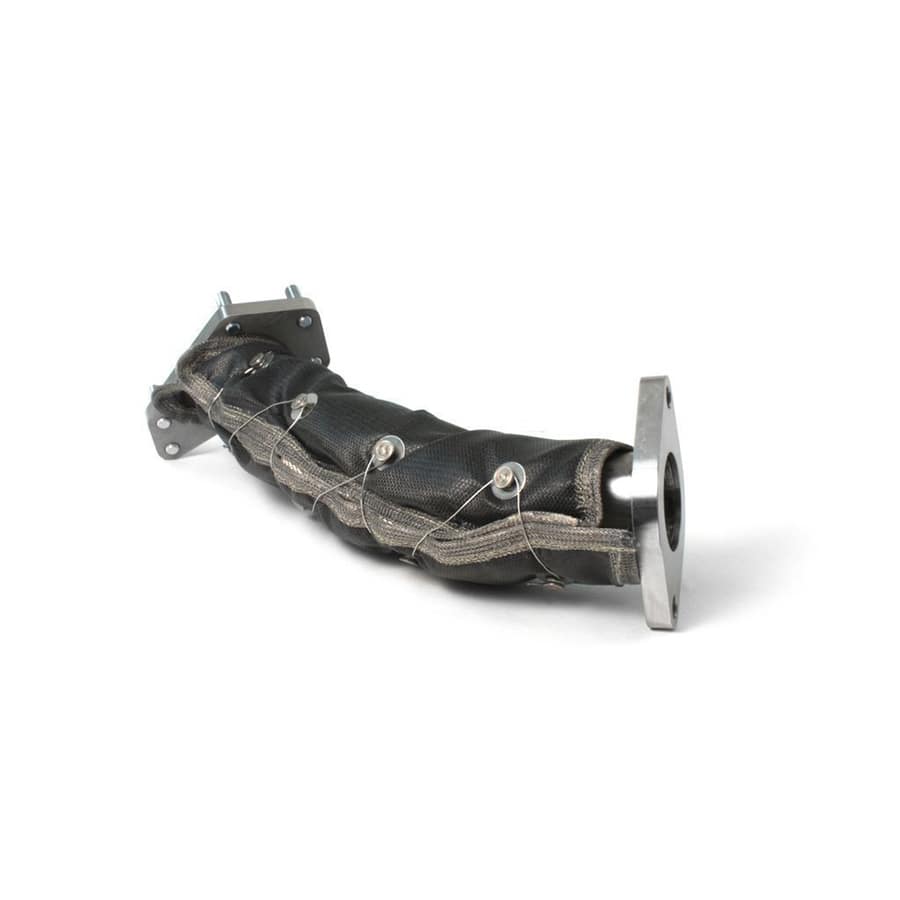
An exhaust pipe insulation heat shield is designed to control the heat generated by high-temperature exhaust piping while limiting heat transfer to nearby components, wiring, hoses, structures, and equipment.
Unlike a conventional metal heat shield that mainly blocks radiant heat, an insulated heat shield can incorporate a thermal insulation layer directly around the exhaust pipe. This creates a more complete thermal management solution for systems where both pipe temperature and surrounding heat exposure need to be controlled.
For industrial engines, generators, vehicles, marine engines, turbocharged systems, and other high-temperature equipment, the appropriate insulation heat shield can be engineered around the actual pipe geometry, operating temperature, installation space, and maintenance requirements.
What Is an Exhaust Pipe Insulation Heat Shield?
An exhaust pipe insulation heat shield is a thermal protection assembly installed around or adjacent to an exhaust pipe.
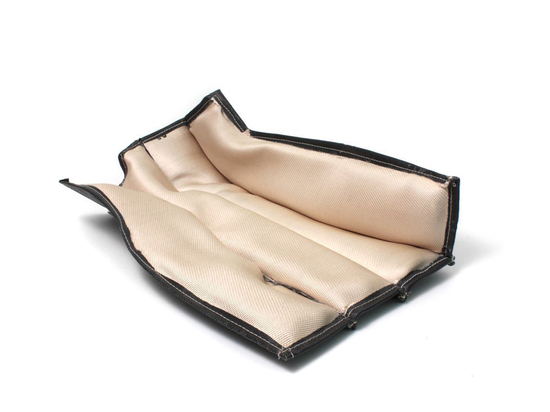
Its construction may include several functional layers:
Layer Typical Function
Outer cover Mechanical protection and resistance to the surrounding environment
Reflective layer Reduces radiant heat transfer
Insulation layer Restricts conductive and convective heat transfer
Inner fabric Protects insulation from direct exposure to the exhaust pipe
Fastening system Allows secure installation and, when required, removal
The exact construction depends on the application.
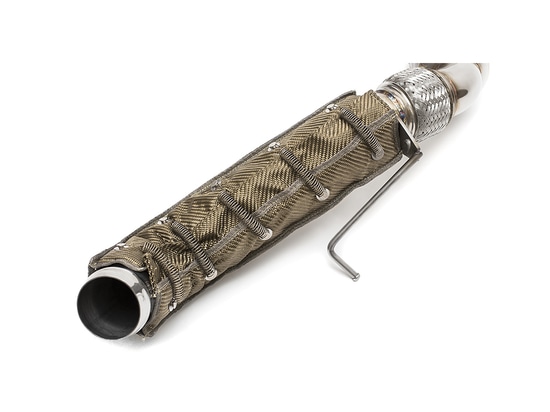
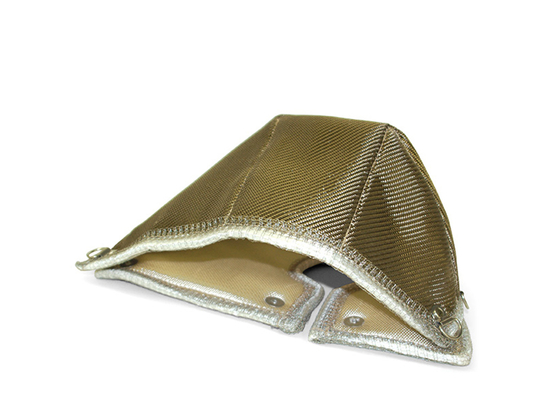
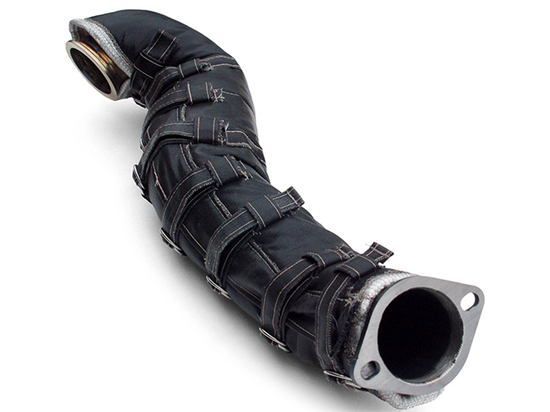
Some systems require a flexible removable blanket. Others may use a sleeve, wrap, rigid shield, or a combination of insulation and reflective materials.
The objective is not simply to cover the exhaust pipe. The insulation heat shield must control heat without interfering with pipe movement, inspection, servicing, or other components.
Why Combine Insulation and Heat Shielding?
Exhaust systems can create several different heat-transfer paths.
The pipe itself reaches a high temperature and transfers heat through direct contact with surrounding structures. At the same time, the hot surface radiates thermal energy toward nearby components.
A conventional heat shield primarily addresses radiant heat.
An insulation layer addresses the temperature of the exhaust pipe surface and reduces heat transfer through the insulation system.
Combining both functions can therefore provide broader thermal protection.
This is particularly useful when an exhaust pipe passes close to:
Electrical wiring
Hydraulic hoses
Fuel lines
Plastic components
Sensors
Engine covers
Composite structures
Operator-access areas
Adjacent exhaust components
Engine-room equipment
The engineering requirement is often to create a controlled thermal boundary around the exhaust system rather than simply install a reflective metal panel.
How Does an Exhaust Pipe Insulation Heat Shield Work?
The system works through a combination of insulation and heat reflection.
The insulation layer increases the thermal resistance between the hot exhaust pipe and the external surface. This reduces the amount of heat reaching the outside of the protection system.
A reflective outer layer can then redirect a portion of radiant energy away from nearby components.
The result is a thermal barrier between the exhaust source and the surrounding environment.
The effectiveness of the system depends on several factors, including:
Exhaust gas temperature
Pipe surface temperature
Insulation thickness
Insulation material
Outer covering material
Installation clearance
Ambient temperature
Airflow around the exhaust
Exposure time
Required external surface temperature
For this reason, selecting an insulation heat shield should be based on the complete thermal environment rather than temperature rating alone.
Exhaust Pipe Insulation Heat Shield Materials
Different materials can be combined according to the required temperature and application conditions.
Common insulation materials include fiberglass, silica fiber, ceramic fiber, and other high-temperature thermal insulation materials.
The outer construction may use fiberglass fabric, silicone-coated fabric, silica fabric, aluminized material, stainless steel mesh, or other protective coverings.
Material Typical Advantage
Fiberglass Flexible and economical for many high-temperature applications
Silica fiber Suitable for very high-temperature thermal protection
Ceramic fiber High thermal resistance for demanding applications
Aluminum foil Reflects radiant heat and provides a lightweight barrier
Aluminized fabric Combines flexibility with reflective thermal protection
Stainless steel mesh Provides mechanical reinforcement and durability
Silicone-coated fabric Adds flexibility and environmental resistance
The final construction can use one material or multiple layers.
For example, a removable exhaust insulation blanket may combine a high-temperature inner fabric, thermal insulation, reflective foil, and a durable outer cover.
Removable Exhaust Pipe Insulation Heat Shields
Removability is important when exhaust components require regular inspection or servicing.
A permanent wrap may need to be cut away before maintenance. A removable insulation heat shield can instead be opened, removed, and reinstalled.
This approach is particularly useful for:
Engine exhaust manifolds
Turbochargers
Exhaust elbows
Flanges
Mufflers
Diesel engine exhaust pipes
Generator exhaust systems
Marine exhaust components
Fastening can be achieved using straps, buckles, hooks, lacing, stainless steel wire, or other application-specific systems.
The fastening design should account for vibration and thermal expansion while maintaining sufficient compression of the insulation layer.
Applications for Exhaust Pipe Insulation Heat Shields
Industrial Engines
Industrial engines often operate continuously under high thermal loads. Exhaust piping may be routed through compact equipment compartments where heat accumulation becomes a significant design concern.
An insulated heat shield can help control external pipe temperatures and reduce heat exposure to adjacent equipment.
Generator Sets
Generator exhaust systems commonly contain hot pipes, elbows, mufflers, and flexible sections.
Insulation heat shields can be designed around these components to reduce heat radiation within the genset enclosure and improve overall thermal management.
Automotive Exhaust Systems
Automotive applications may require protection for exhaust pipes located close to wiring, hoses, body panels, sensors, or other temperature-sensitive components.
The protection system can be designed around the available clearance and specific pipe geometry.
Marine Engines
Marine engine rooms often have limited space and numerous heat-sensitive systems installed close to exhaust components.
A flexible exhaust insulation heat shield can provide localized thermal protection while allowing access for inspection and maintenance.
Turbocharged Exhaust Systems
Turbochargers and associated exhaust piping can produce particularly high temperatures.
Protection may be required around turbo outlets, exhaust elbows, downpipes, and nearby components. A multilayer insulation system can be engineered for these areas according to operating conditions.
Exhaust Pipe Heat Shield vs Insulation Heat Shield
The terms are sometimes used interchangeably, but the construction can be different.
A conventional exhaust pipe heat shield may consist primarily of a metal or reflective barrier positioned between the hot pipe and a sensitive component.
An exhaust pipe insulation heat shield generally incorporates thermal insulation into the protective assembly.
Feature Conventional Heat Shield Insulation Heat Shield
Radiant heat protection Yes Yes
Thermal insulation Limited Yes
Surface temperature reduction Limited Higher potential
Flexible construction Application dependent Common
Removable design Possible Common
Complex geometry Moderate Highly customizable
Maintenance access Depends on design Can be designed for removal
Neither solution is universally better.
The appropriate design depends on whether the primary concern is radiant heat, surface temperature, available installation space, or a combination of these factors.
How to Select the Right Exhaust Insulation Heat Shield
Several engineering parameters should be defined before specifying the product.
1. Determine the Temperature
Identify the exhaust pipe operating temperature and the maximum expected temperature.
Do not select insulation solely from the exhaust gas temperature. The actual pipe surface temperature and the required external temperature are also important.
2. Measure the Pipe Geometry
Record pipe diameter, length, bends, elbows, flanges, junctions, and connection points.
For irregular exhaust systems, custom-fabricated insulation blankets can provide a closer fit than standard products.
3. Check Installation Clearance
Available space around the pipe determines the maximum insulation thickness and outer construction.
A thicker insulation layer is not always practical when the exhaust system is installed in a confined compartment.
4. Consider Maintenance
If the pipe, flange, sensor, or connection requires regular inspection, use a removable construction.
Separate blanket sections can also simplify maintenance around complicated exhaust assemblies.
5. Consider Vibration and Movement
Engine exhaust systems can experience vibration, thermal expansion, and mechanical movement.
The insulation heat shield must accommodate these conditions without becoming loose or interfering with surrounding equipment.
Custom Exhaust Pipe Insulation Heat Shield Design
Exhaust systems rarely have completely uniform geometry.
A custom insulation heat shield can be manufactured to follow individual pipe sections and accommodate bends, elbows, flanges, brackets, sensors, and connection points.
A custom design can also divide a long exhaust assembly into multiple removable sections.
This provides several advantages:
Better fit around complex geometry
Reduced unnecessary material
Easier installation
Easier removal
Improved access to service points
Better clearance management
More consistent thermal coverage
For OEM and industrial applications, the blanket can be developed according to drawings, dimensions, photographs, samples, or other engineering requirements.
Exhaust Thermal Protection Beyond the Pipe
The purpose of an insulation heat shield is not limited to reducing the temperature of the exhaust pipe itself.
The larger objective is often to manage the thermal environment around the exhaust system.
By controlling heat transfer, the system can help protect temperature-sensitive components and reduce unwanted heat accumulation.
This can be especially important in enclosed engine compartments, generator housings, machinery rooms, and marine engine rooms where natural ventilation is limited.