#Product Trends
Auto Exhaust Blanket Material: Fiberglass, Silica and Heat Shield Options
Exhaust Blanket Material
Auto Exhaust Blanket Material: Fiberglass, Silica and Heat Shield Options
Choosing the Right Material for Automotive Exhaust Thermal Protection
The material used in an auto exhaust blanket directly affects its temperature resistance, insulation performance, flexibility, durability, and service life.
Automotive exhaust systems operate in a demanding thermal environment. Exhaust manifolds, turbochargers, downpipes, headers, catalytic-converter areas, and other components can generate substantial heat close to wiring, hoses, body panels, sensors, and other temperature-sensitive components.
For this reason, an automotive exhaust blanket is normally constructed from multiple materials rather than a single layer.
The appropriate combination depends on exhaust temperature, available space, required heat reduction, vibration, moisture exposure, mechanical abrasion, and whether the blanket needs to be removable.
What Is Auto Exhaust Blanket Material?
Auto exhaust blanket material refers to the fabrics, insulation layers, reflective barriers, reinforcement materials, and fastening components used to manufacture a thermal blanket for an automotive exhaust system.
A typical blanket may contain:
High-temperature inner fabric
Thermal insulation
Reflective foil or aluminized fabric
Protective outer fabric
Stainless steel reinforcement
Mechanical fastening components
Each layer performs a specific function.
The inner surface must tolerate contact with a hot exhaust component. The insulation controls heat transfer, while the outer layer protects the assembly and may provide additional radiant heat management.
The final construction can therefore be engineered around the actual requirements of the vehicle or exhaust component.
Why Material Selection Matters
Two exhaust blankets can have completely different thermal performance even when they look similar externally.
The important variables include:
Material Property Why It Matters
Temperature resistance Determines whether the material can survive the exhaust environment
Thermal conductivity Influences heat transfer through the insulation
Flexibility Determines how well the blanket follows exhaust geometry
Mechanical strength Affects resistance to vibration and handling
Abrasion resistance Important where components are close together
Moisture resistance Relevant to outdoor and vehicle applications
Reflectivity Helps control radiant heat
Weight Important where lightweight construction is preferred
Removability Determines whether the blanket can be serviced and reused
Selecting material based only on maximum temperature can therefore result in an unsuitable design.
The complete operating environment must be considered.
Fiberglass for Automotive Exhaust Blankets
Fiberglass is one of the most commonly used high-temperature textile materials for exhaust thermal protection.
It offers a useful combination of flexibility, thermal resistance, mechanical strength, and cost efficiency.
Fiberglass fabric can be used as an inner liner, outer cover, or structural textile layer depending on the blanket design.
It is suitable for many automotive applications where the thermal requirements fall within the capability of fiberglass-based constructions.
Typical applications include:
Exhaust pipes
Headers
Exhaust manifolds
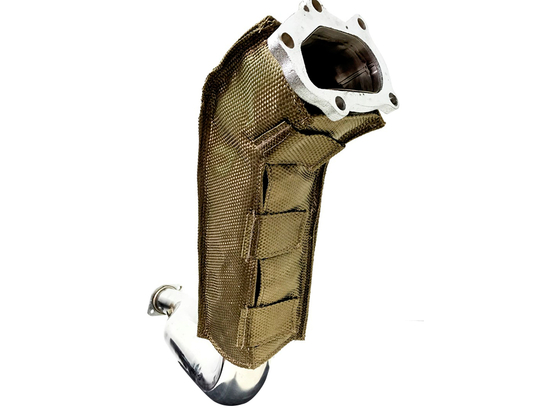
Downpipes
Mufflers
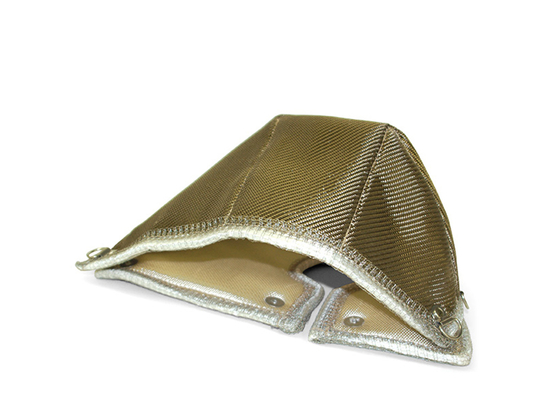
Turbocharger components
Exhaust elbows
Fiberglass can also be combined with insulation and reflective materials to create a multilayer automotive exhaust blanket.
Silica Fabric for High Temperature Exhaust Applications
Silica fabric is selected when a higher-temperature textile solution is required.
Compared with conventional fiberglass fabric, silica-based materials can provide greater resistance in demanding thermal environments.
This makes silica fabric useful for areas such as:
Turbocharger outlets
High-temperature exhaust manifolds
Performance exhaust systems
Heavy-duty automotive exhaust components
High-temperature industrial vehicle systems
Silica fabric can be used as the inner protective layer or as part of a multilayer blanket construction.
The correct grade and construction should be selected according to the actual operating temperature rather than simply choosing the material with the highest published rating.
Ceramic Fiber Insulation
Ceramic fiber is primarily used as an insulation layer where significant thermal resistance is required.
It can reduce heat transfer through the exhaust blanket while maintaining relatively low weight compared with some rigid insulation systems.
A ceramic fiber layer may be positioned between high-temperature fabrics or reflective layers.
This creates a thermal barrier around the exhaust component.
The thickness can be adjusted according to the required thermal performance and the available clearance around the exhaust system.
Aluminum Foil and Aluminized Materials
Reflective materials play a different role from traditional thermal insulation.
Aluminum foil and aluminized fabrics can reflect radiant heat away from nearby surfaces.
This can be useful when an exhaust component is positioned close to another component that is sensitive to radiant heat.
A reflective layer may therefore be combined with insulation rather than used as the only thermal protection layer.
For example, a multilayer automotive exhaust blanket may use:
Hot exhaust component → high-temperature fabric → insulation → reflective layer → protective outer fabric
This construction addresses both heat transfer through the blanket and radiant heat from the hot exhaust system.
Stainless Steel Mesh and Reinforcement
Automotive exhaust systems experience vibration and thermal cycling.
In some applications, reinforcement is therefore required.
Stainless steel mesh can be incorporated into the construction to provide additional mechanical support and resistance to handling.
It can also be used as part of a protective outer structure where the blanket is exposed to abrasion or mechanical contact.
The reinforcement should not compromise the flexibility required to install or remove the blanket.
Auto Exhaust Blanket Material by Application
Different automotive exhaust components can require different material combinations.
Application Typical Material Consideration
Exhaust pipe Fiberglass or silica fabric with insulation
Exhaust manifold High-temperature fabric with higher-performance insulation
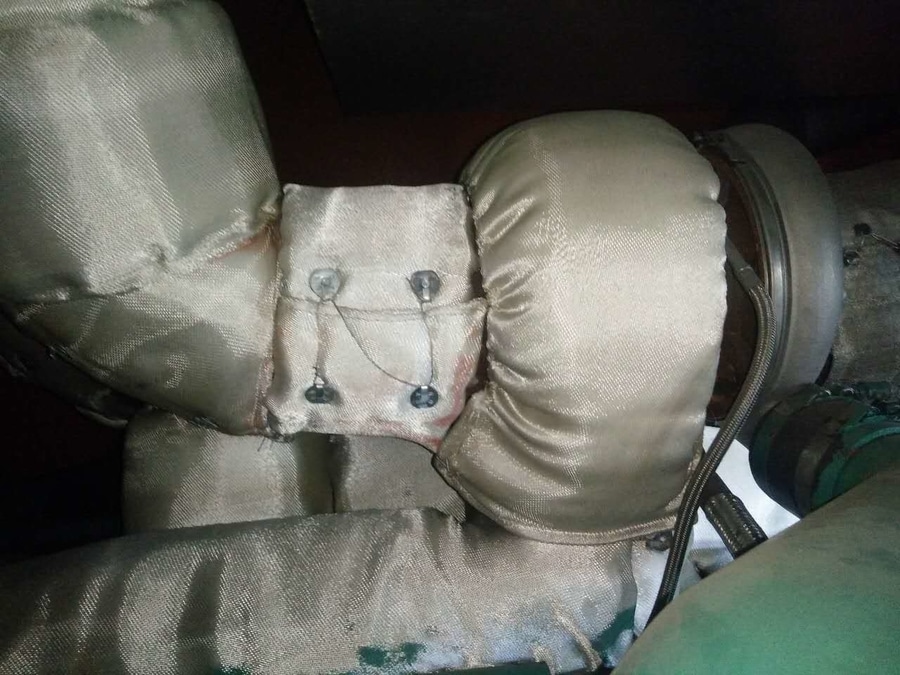
Turbocharger Silica or ceramic-based multilayer construction
Header Flexible high-temperature fabric and insulation
Downpipe Fiberglass, silica, or reflective multilayer system
Muffler Thermal insulation with protective outer cover
Exhaust elbow Custom-shaped multilayer blanket
Performance exhaust Lightweight high-temperature construction
These are general engineering directions rather than universal specifications.
The correct material should always be determined by the actual temperature and mechanical environment.
Auto Exhaust Blanket vs Exhaust Wrap
An exhaust wrap is generally a continuous material wrapped around an exhaust component.
An auto exhaust blanket is normally fabricated as a shaped component.
This difference becomes important when the exhaust system contains irregular geometry.
A custom blanket can incorporate openings and shaped sections for:
Sensors
Flanges
Brackets
Bolts
Connection points
Pipe bends
Adjacent components
It can also be designed as a removable assembly.
For vehicles that require regular service access, this can be more practical than repeatedly removing and reinstalling a tightly wrapped material.
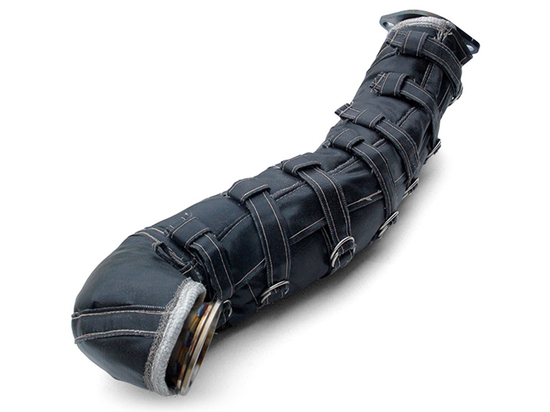
Removable Automotive Exhaust Blankets
Removability is particularly valuable for automotive applications where exhaust components may need inspection or replacement.
A removable blanket can be secured with:
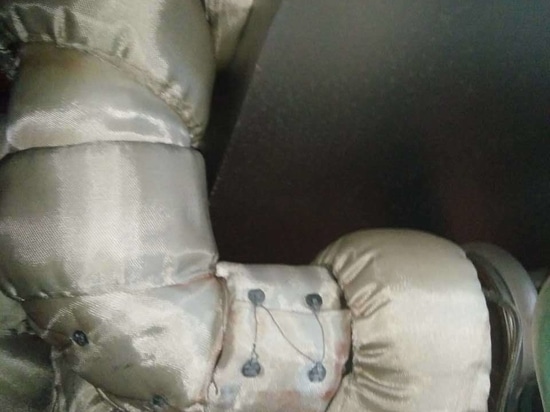
Stainless steel wire
Straps
Buckles
Hooks
Lacing
High-temperature fastening systems
The fastening system should accommodate thermal expansion and vibration without allowing the blanket to loosen during operation.
A properly designed removable blanket can be removed during service and reinstalled without replacing the insulation material.
Material Selection for Turbocharger Exhaust Systems
Turbocharged systems require careful material selection because turbocharger-related exhaust components can operate at particularly high temperatures.
A blanket for a turbocharger or nearby exhaust pipe should consider both temperature and geometry.
The insulation layer must provide sufficient thermal resistance, while the fabric facing must tolerate the hot environment.
A reflective outer layer may also be useful where nearby components are exposed to radiant heat.
The design should maintain appropriate clearance around moving or serviceable components.
Automotive Exhaust Heat Protection
The purpose of an auto exhaust blanket is not simply to make the exhaust system cooler.
The larger objective is to manage heat within the vehicle.
Reducing heat transfer from an exhaust component can help protect nearby:
Electrical wiring
Rubber hoses
Plastic components
Sensors
Fuel-system components
Engine covers
Body panels
Intake components
In compact engine compartments, controlling localized exhaust heat can be an important part of the overall thermal-management strategy.
How to Choose Auto Exhaust Blanket Material
A practical material-selection process should begin with the operating conditions.
1. Determine Exhaust Temperature
Identify the normal operating temperature and maximum expected temperature of the component.
The material should provide an appropriate safety margin rather than operating continuously at its absolute temperature limit.
2. Identify the Component
A straight exhaust pipe has different requirements from a turbocharger, manifold, header, or muffler.
The geometry and heat concentration should influence the material construction.
3. Measure Available Clearance
The insulation thickness increases the outside diameter of the protected component.
If the blanket is installed in a confined engine bay, the available space must be measured before determining the insulation thickness.
4. Consider Vibration
Automotive exhaust systems move and vibrate during operation.
Flexible materials and appropriate fastening systems are therefore important.
5. Consider Service Requirements
If the component needs regular inspection, specify a removable blanket.
6. Evaluate the Surrounding Environment
Moisture, oil, dirt, abrasion, road debris, and mechanical contact can influence the choice of outer material.
Custom Auto Exhaust Blanket Material
There is no single material combination that is ideal for every automotive exhaust system.
A custom blanket can be developed by combining different layers according to the specific thermal and mechanical requirements.
For example, one application may prioritize lightweight construction and flexibility, while another may require maximum insulation performance.
A custom design can also account for complex exhaust geometry.
This is especially useful for:
Custom exhaust systems
Specialty vehicles
Heavy-duty vehicles
Performance vehicles
Engine development programs
Prototype vehicles
OEM applications
The blanket pattern can be developed using component dimensions, drawings, samples, or photographs.
Common Mistakes When Selecting Exhaust Blanket Material
Choosing Material Only by Temperature Rating
A material may tolerate a high temperature but still be unsuitable for a particular mechanical or environmental condition.
Ignoring Radiant Heat
Insulation and radiant heat shielding perform different functions.
If a sensitive component is positioned very close to the exhaust, a reflective layer may be beneficial.
Using Excessive Insulation Thickness
More insulation is not always practical.
The finished blanket must fit within the available installation space.
Ignoring Fastening
Even excellent insulation materials can perform poorly if the blanket becomes loose because of engine vibration.
Treating Every Exhaust Component the Same
A turbocharger, manifold, pipe, and muffler may require different constructions.
Material selection should therefore be application-specific.