#Product Trends
Exhaust Lagging Blanket for High Temperature Pipe Insulation
Exhaust Lagging Blanket
Exhaust Lagging Blanket for High Temperature Pipe Insulation
Flexible Thermal Protection for High Temperature Exhaust Piping
An exhaust lagging blanket is a flexible thermal insulation solution designed to cover high-temperature exhaust pipes and related components. It helps reduce heat transfer from the exhaust system to the surrounding environment while providing a practical alternative to permanent insulation methods.
Exhaust lagging is widely considered for industrial engines, diesel generators, marine engines, heavy equipment, power generation systems, and other machinery where hot exhaust piping is installed close to heat-sensitive components.
Unlike simple exhaust wrapping, a lagging blanket can be manufactured as a shaped, multilayer assembly that follows the geometry of the exhaust system. It can also be designed for removal when inspection or maintenance is required.
What Is an Exhaust Lagging Blanket?
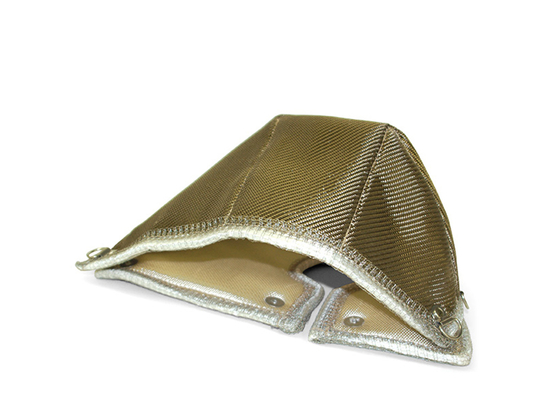
An exhaust lagging blanket is a prefabricated thermal insulation cover installed around a hot exhaust pipe or exhaust component.
The blanket normally consists of several layers, with each layer serving a different function.
A typical construction may include:
Layer Function
Inner fabric Protects the insulation from the hot exhaust surface
Thermal insulation Reduces heat transfer through the blanket
Reflective layer Helps control radiant heat
Outer cover Provides mechanical and environmental protection
Fastening system Secures the blanket around the component
The actual construction can be adjusted according to operating temperature, installation environment, available clearance, and required thermal performance.
For complex exhaust systems, the blanket may consist of multiple individually shaped sections rather than one continuous cover.
Why Is Exhaust Pipe Lagging Used?
Hot exhaust piping can become a major source of unwanted heat inside an equipment enclosure.
When an uninsulated pipe operates at elevated temperature, heat can be transferred to surrounding air and nearby components. In a confined engine compartment, this can contribute to higher ambient temperatures around wiring, hoses, sensors, hydraulic components, and other equipment.
Exhaust pipe lagging creates thermal resistance around the hot pipe.
The main objectives can include:
Reducing external surface temperature
Limiting heat transfer to surrounding equipment
Reducing radiant heat exposure
Improving engine compartment thermal management
Protecting nearby temperature-sensitive components
Improving operator safety around accessible hot surfaces
Reducing heat accumulation in enclosed spaces
The actual temperature reduction depends on the exhaust temperature, insulation construction, thickness, installation conditions, and surrounding airflow.
Exhaust Lagging Blanket vs Exhaust Wrap
Exhaust lagging blanket and exhaust wrap can perform similar thermal-management functions, but they are not necessarily the same type of product.
An exhaust wrap is generally installed by wrapping material continuously around the pipe.
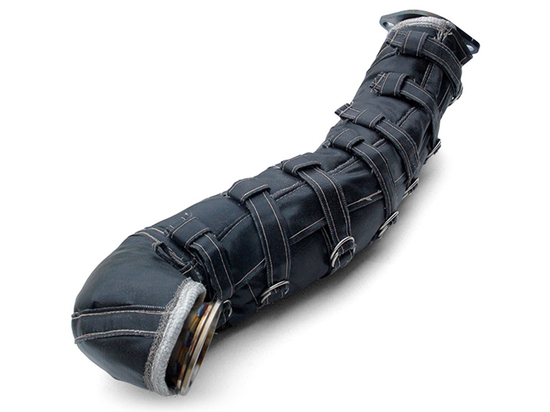
A lagging blanket is typically fabricated as a dedicated insulation component that can be shaped around the pipe and secured with a fastening system.
Feature Exhaust Wrap Exhaust Lagging Blanket
Installation method Continuous wrapping Prefabricated sections
Complex geometry Limited to moderate Highly adaptable
Removal Often inconvenient Can be designed for removal
Reinstallation Depends on material Generally easier
Custom shaping Limited Strong capability
Maintenance access Can require unwinding Individual sections can be removed
Industrial applications Suitable Particularly suitable
For a simple straight pipe, wrapping may be sufficient.
For industrial equipment containing elbows, flanges, joints, valves, expansion areas, or removable components, a fabricated lagging blanket can provide a more practical solution.
Materials Used in Exhaust Lagging
Material selection depends heavily on temperature and application requirements.
Fiberglass-based fabrics are commonly considered for many high-temperature thermal protection applications. Silica and ceramic fiber materials can be selected for more demanding temperature conditions.
The outer surface may use fiberglass fabric, silicone-coated fabric, aluminized fabric, silica fabric, or other high-temperature textile constructions.
A reflective foil layer may also be incorporated where radiant heat control is important.
Fiberglass
Fiberglass is widely used because it provides a combination of flexibility, thermal resistance, availability, and cost efficiency.
It can be used as a fabric facing or as part of a multilayer insulation construction.
Silica Fabric
Silica fabric is suitable for applications requiring higher-temperature resistance.
It can be used as an inner or outer fabric depending on the thermal environment and mechanical requirements.
Ceramic Fiber
Ceramic fiber insulation can provide high-temperature performance where conventional fiberglass insulation is insufficient.
It is often considered for severe thermal environments around engine exhaust components.
Reflective Materials
Aluminum foil and aluminized fabrics can be used to reduce radiant heat transfer.
A reflective layer is particularly useful when the exhaust system is positioned close to another heat-sensitive surface.
Removable Exhaust Lagging Blanket Design
One of the major advantages of a blanket-based lagging system is the ability to make it removable.
Industrial exhaust components frequently require inspection.
Flanges may need to be opened, sensors may need to be replaced, and exhaust connections may need periodic inspection.
A permanent insulation system can make these operations more difficult.
A removable lagging blanket can instead be divided into sections.
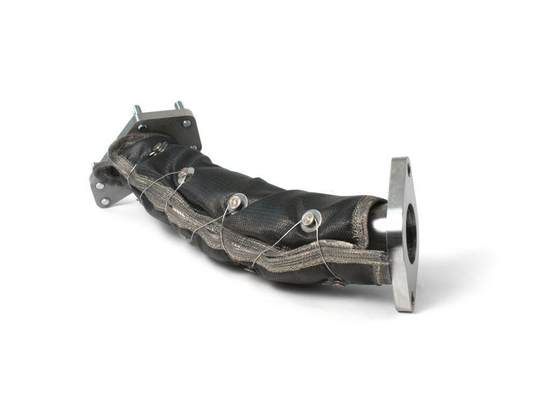
Each section can be secured with straps, buckles, hooks, lacing, wire, or another fastening arrangement.
The fastening system should remain secure under vibration and thermal cycling while still allowing maintenance personnel to remove the blanket when necessary.
Exhaust Pipe Lagging for Industrial Engines
Industrial engines frequently contain long exhaust pipe runs connecting the engine, turbocharger, muffler, and exhaust outlet.
These systems can operate continuously for extended periods.
An exhaust lagging blanket can be used on selected pipe sections where thermal management is most important.
Rather than insulating every component indiscriminately, the protection system can be concentrated around areas where heat transfer creates the greatest engineering concern.
This can include:
Exhaust manifolds
Turbocharger outlets
Exhaust elbows
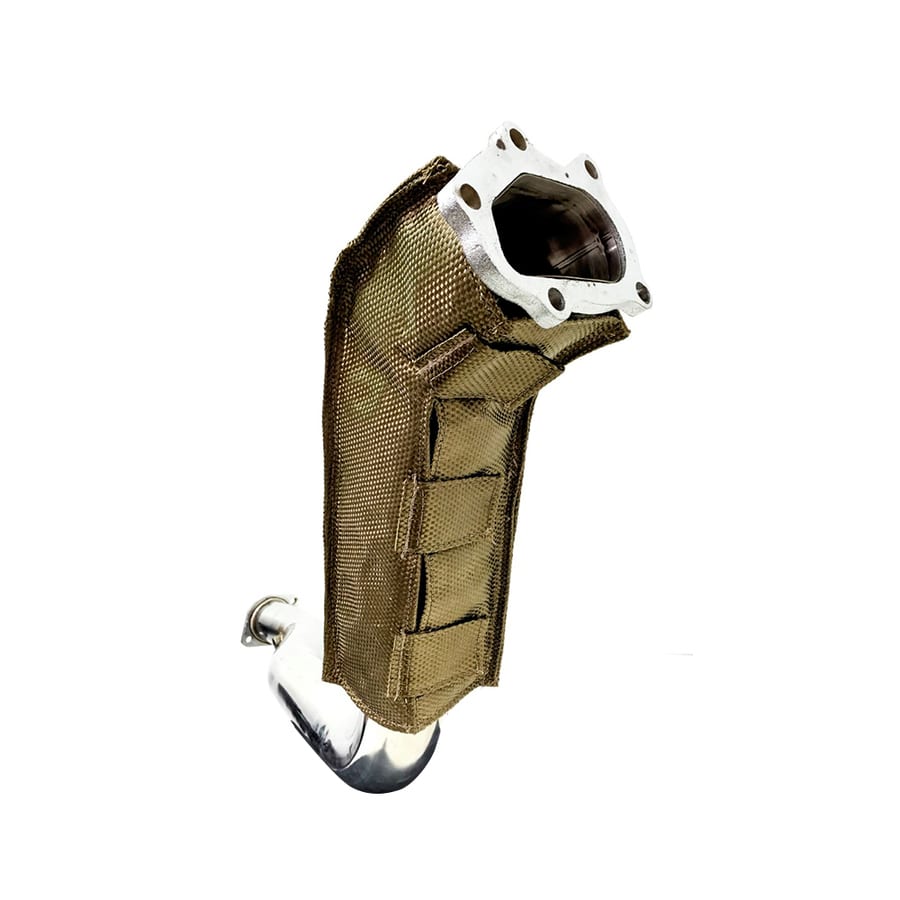
Downpipes
Straight exhaust sections
Flanges
Mufflers
Exhaust expansion areas
Generator exhaust connections
Exhaust Lagging for Generator Systems
Generator sets often operate inside relatively compact enclosures.
The exhaust pipe can therefore contribute significantly to the thermal load within the enclosure.
Insulating selected exhaust components can help reduce heat released into the surrounding space.
A generator exhaust lagging blanket can be designed around the pipe diameter, routing, bends, mounting points, and available clearance.
For serviceable equipment, removable sections are particularly useful.
The blanket can be removed before servicing and returned to its original position after maintenance.
Marine Exhaust Lagging Applications
Marine engine rooms present a different set of requirements.
Space is limited, equipment is densely installed, and exhaust components can be located close to electrical systems, fuel-related equipment, hoses, and structural surfaces.
An exhaust lagging blanket can provide localized thermal protection without requiring a rigid shield around the entire exhaust system.
For marine applications, the outer material and fastening system should also be selected according to the surrounding environment.
Custom Exhaust Lagging Blankets
Exhaust systems are rarely identical from one machine to another.
Even two engines using similar exhaust components may have different pipe routing, flange positions, brackets, clearances, or service requirements.
For this reason, custom exhaust lagging blankets are often more practical than generic covers.
A custom blanket can be manufactured around:
Pipe diameter
Pipe length
Elbows
Flanges
Reducers
Expansion joints
Sensors
Brackets
Connection points
Access areas
The blanket can also be divided into several sections where necessary.
This approach allows thermal protection to be integrated with the mechanical design of the exhaust system rather than treating insulation as an afterthought.
How to Specify an Exhaust Lagging Blanket
Before ordering an exhaust lagging blanket, several parameters should be established.
Operating Temperature
Provide the normal and maximum expected exhaust pipe temperature.
The insulation and fabric construction should be selected according to the actual thermal environment.
Pipe Dimensions
Pipe outside diameter, length, bends, and connection geometry are important for determining the blanket pattern.
Insulation Thickness
Thickness affects both thermal performance and available installation clearance.
The thickest possible insulation is not necessarily the best solution if the surrounding equipment leaves limited space.
Installation Environment
Consider vibration, moisture, oil exposure, mechanical contact, airflow, and accessibility.
Maintenance Requirements
If the exhaust component needs periodic servicing, specify a removable design from the beginning.
Required External Temperature
Where personnel safety or component protection is the objective, define the desired external surface temperature or thermal-management target.
Engineering Considerations for Exhaust Pipe Lagging
A good lagging system must do more than withstand temperature.
It must remain mechanically stable during operation.
Engine vibration can cause repeated movement between the exhaust pipe and the insulation system. Thermal expansion can also change the dimensions of the pipe during operation.
The blanket should therefore be designed with appropriate flexibility and fastening.
Clearance is another important consideration.
The completed insulated diameter may be significantly larger than the original exhaust pipe diameter. The designer should verify that the blanket does not interfere with wiring, hoses, brackets, engine covers, or adjacent components.
For removable systems, fastening points should also be positioned so that technicians can access them without dismantling unrelated equipment.
When Should You Choose an Exhaust Lagging Blanket?
An exhaust lagging blanket is particularly suitable when the application requires:
Flexible thermal insulation
Protection around irregular exhaust geometry
Removable insulation
Reduced external pipe temperature
Protection for nearby components
Improved engine-room thermal management
Custom-fit insulation
Reusable maintenance access
For simple applications, a standard exhaust sleeve or wrap may be adequate.
For larger industrial exhaust systems with complex geometry and regular maintenance requirements, a fabricated lagging blanket can offer greater flexibility.